
Reviewed · HISTORICAL TOURS
Galway Historic city Tour – 2.5hr Family & Friends Private groups
Galway rewards slow walking. This 2.5-hour private tour links the city’s medieval lanes, churches, merchant houses, river views, and pub streets into one easy route. I like the personal format, especially since the guide can adjust the walk to your group’s interests. I also like the mix of famous sights and small details, from the Claddagh ring connection to the archaeological remains of the Hall of the Red Earl.
The tour is especially useful on a first visit because it helps you understand how Galway grew from a Gaelic settlement into a walled trading city. Guide Ger is praised for explaining how to reach places later, pointing out local food spots, and adding stories instead of simply naming buildings. The main consideration is pace: there are many stops, and the walk covers a lot of ground, so anyone with mobility concerns should ask about the shorter alternative before booking.
In This Review
- Key points at a glance
- Eyre Square gives you the Galway backstory
- Williamsgate Street and the small clues of modern Galway
- Franciscan Church and the city walls
- The River Corrib and Galway Cathedral
- Lynch’s Castle explains Galway’s merchant power
- Church Lane, Market Street, and the Lynch memorial
- St Nicholas’ Church and the Saturday Market
- The Latin Quarter, King’s Head, and Quay Street
- The Claddagh village from Wolfe Tone Bridge
- Spanish Arch and the Hall of the Red Earl
- Naughton’s Pub, Kirwan’s Lane, and living culture
- Abbeygate Street and the final stop
- What the $360.93 group price really buys
- Who will enjoy this Galway walk?
- Should you book it?
- FAQ
- Where does the Galway Historic City Tour start?
- Where does the tour end?
- How long does the tour last?
- Is this a private tour?
- Is admission included?
- Can the tour be changed for my group?
Key points at a glance
- Start in Eyre Square: Meet at the front entrance of The Hardiman Hotel, then learn how Galway’s merchant families shaped the city.
- See medieval Galway in layers: The route includes old walls, Lynch’s Castle, St Nicholas’ Church, Kirwan’s Lane, and the Hall of the Red Earl.
- Hear stories behind the symbols: The Claddagh ring, the Lynch memorial, Nora Barnacle, and Galway’s 14 merchant tribes all get their place.
- Private and adaptable: Only your group takes part, with the route adjustable by agreement.
- Allow for weather and walking: The experience lasts about 2 hours 35 minutes and can be cancelled for poor weather.
- Best value for a group: At $360.93 for up to 15 people, the per-person cost drops sharply when shared by family or friends.
Eyre Square gives you the Galway backstory
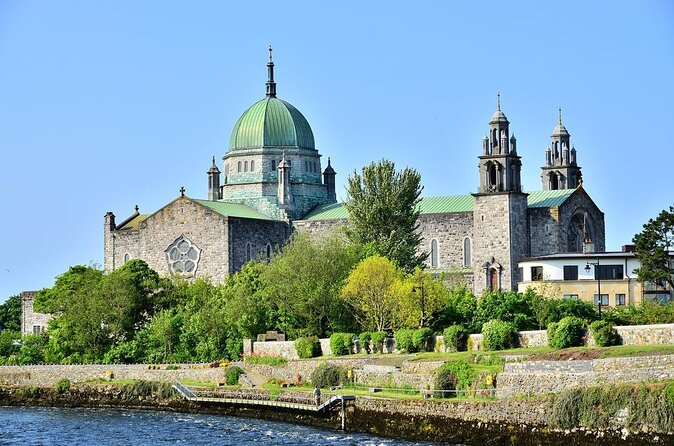
The tour begins at the front entrance of The Hardiman Hotel on Eyre Square. This is a sensible meeting point because you are already in central Galway, close to shops, restaurants, bus links, and the old town.
Your guide starts with the broad outline: Galway began as a Gaelic settlement on Ireland’s west coast, then grew into a prosperous walled city under Anglo-Norman influence. The story becomes more useful when it is tied to the square itself. You will see the old Browne Doorway, banners representing Galway’s 14 merchant tribes, the John F. Kennedy memorial, and the Quincentenary Fountain.
I like this opening because it gives you a framework for the rest of the walk. Galway’s old buildings can seem like a jumble of stone fronts and narrow streets until you understand the rival families, trade links, walls, churches, and river crossings that shaped them.
The stop lasts about 17 minutes. Admission is free, and the guide provides a tour itinerary. It is also a good time to ask questions about the rest of your day, especially if you want advice on food, nearby sights, or walking routes.
More History Tours in Galway
- Galway: Dark History Guided City Walking Tour
★ 4.8 · 236 reviews - The Dark History Tour of Galway City
★ 5.0 · 146 reviews - Galway City on Foot with Seán: Stories, History, Local Tips, Chat and More..
★ 5.0 · 64 reviews
Williamsgate Street and the small clues of modern Galway
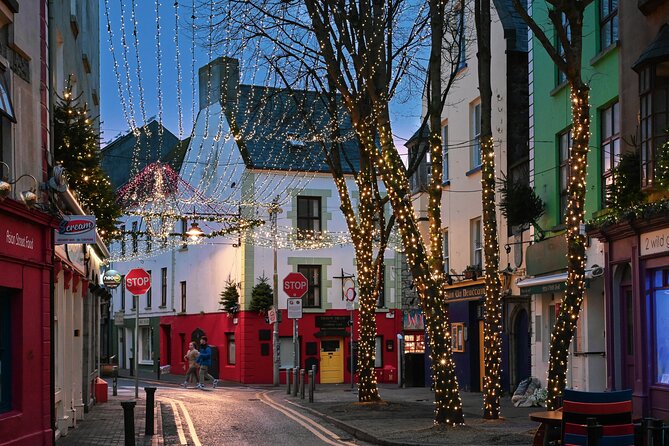
From the square, you continue along Williamsgate Street. This section combines present-day Galway with traces of older trade and craft traditions.
You pass the elegant Browne Thomas building and shops associated with Galway’s famous Claddagh rings. The ring is not just a souvenir design. Its connection to Galway gives the later Claddagh discussion more meaning, since the tour eventually points across the River Corrib toward the old Claddagh fishing village.
If time allows, the guide also pauses at the Oscar Wilde statue, presented by Estonia to Ireland in 2004. This is a short stop, about six minutes, but it adds a modern cultural note before the route turns toward older religious buildings.
Franciscan Church and the city walls
A short diversion down Eglinton Street brings you past the Franciscan Friary church. The church has a small graveyard at the rear, linked with burials from the mid-17th and early 18th centuries.
The stop is only about five minutes, so do not expect a long interior visit. Its value comes from seeing how religious buildings and burial grounds fit into the city’s older street plan.
You then enter the Eyre Square Centre to view sections of Galway’s 13th-century medieval walls. This is one of the more unusual moments on the route. The walls are not presented in an isolated castle setting. They appear within a modern shopping centre, which makes the city’s past feel particularly close to ordinary daily life.
The wall stop lasts about seven minutes. If you prefer museums and large monuments, this may feel brief. If you enjoy noticing old structures in unexpected places, it is a useful lesson in how Galway’s medieval footprint survives.
The River Corrib and Galway Cathedral
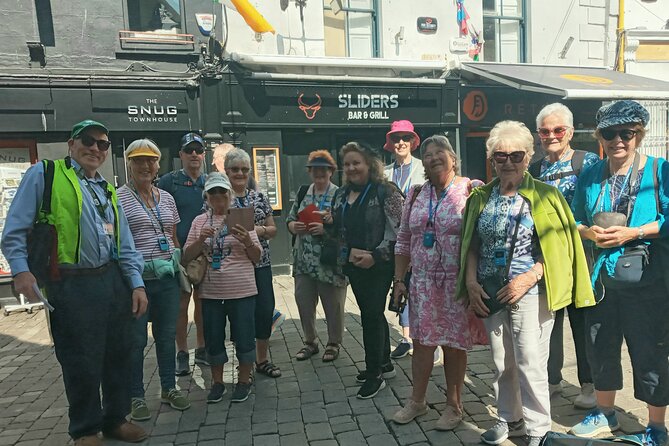
The route continues toward a pedestrian bridge over the River Corrib. From here, you pause for views of Galway Cathedral and the Franciscan Chapel.
The cathedral is described as one of Europe’s newest stone cathedrals, a reminder that Galway’s story does not stop with its medieval buildings. The bridge also gives you a change of scene after several narrow streets. You can take photographs and see how the river helps define the city.
This is a viewpoint stop rather than a full cathedral visit. The scheduled time is about eight minutes, so keep your expectations clear. The guide explains what you are looking at, but the main purpose is orientation and a good view.
Something completely different for another day:
- Galway to Cliffs of Moher, Aillwee Cave & Dunguaire Castle Tour
★ 5.0 · 3,058 reviews - From Galway: Full-Day Cliffs of Moher & Burren Guided Tour
★ 4.8 · 2,815 reviews - Galway to Inisheer Aran Islands, Cliffs of Moher and Boat Trip
★ 5.0 · 2,517 reviews - From Galway: Aran Islands and Cliffs of Moher Tour & Cruise
★ 4.8 · 2,283 reviews
Lynch’s Castle explains Galway’s merchant power
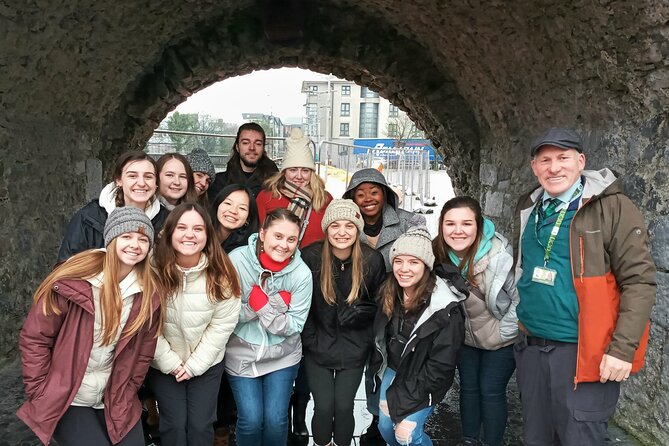
The tour returns along the River Walk and reaches the intersection where Lynch’s Castle occupies a prominent corner. This four-story rectangular mansion is considered the oldest building in Galway and one of Ireland’s finest surviving town castles.
This is where the story of Galway’s powerful families becomes concrete. The Lynch family lived here until the mid-17th century, and the building’s crests and roundels help show how family identity was placed directly onto the city streets.
The stop takes about ten minutes. You will hear about the building rather than tour a large furnished interior, but that suits Galway. Much of the city’s interest is found on the outside, where doorways, coats of arms, and unusual building shapes reveal who once had influence.
Church Lane, Market Street, and the Lynch memorial
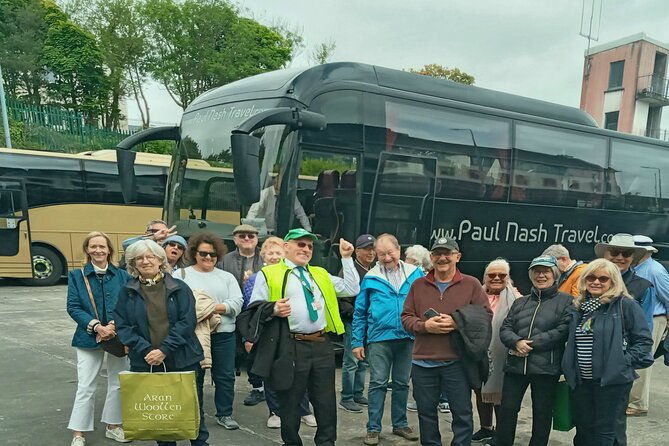
Next comes Church Lane, once known as Dead Man’s Lane because funeral processions passed through it toward an old graveyard. The route then continues through Market Street and toward Courthouse Square.
This part of the walk is less about one major sight and more about reading the city’s street names and connections. You learn how older movement through Galway followed churches, graveyards, courts, and trading streets.
At Courthouse Square, the guide explains that Galway once had separate county and city courthouses. One remains, with the Town Hall Theatre opposite. The stop lasts about five minutes.
Nearby is the former home of Nora Barnacle, associated with James Joyce and the date now known as Bloomsday, June 16, 1904. The house is believed to be Ireland’s smallest museum. The tour passes close to it rather than presenting it as a central scheduled stop, so ask your guide if this detail matters to you.
The Lynch memorial then provides one of the tour’s strongest stories. A 15th-century window recalls Mayor James Lynch FitzStephen, whose son Walter became involved in a love rivalry and a violent confrontation. The tale ends with the father, acting as a strict justice of the peace, issuing the ultimate punishment to his own son.
The memorial dates from 1854 and is a popular stopping point. The story is dramatic, but the guide also explains how the window became part of Galway’s civic memory.
St Nicholas’ Church and the Saturday Market
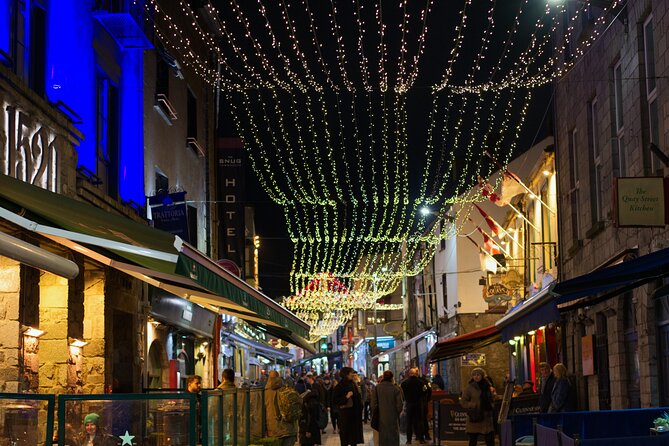
St Nicholas’ Collegiate Church is one of the route’s major sights. This 700-year-old building is the largest medieval church in Ireland still in continuous use.
The church was originally Catholic and now functions as a Protestant church. That change reflects the religious and political shifts Galway experienced over the centuries. Christopher Columbus is also said to have worshipped here in 1477 before his voyage of discovery, adding a famous international connection to the visit.
The church stop lasts about nine minutes, with admission included in the tour. For the 10 a.m. tour, you can receive discounted tickets for the church’s own guided visits. Those operate Monday through Friday at 11 a.m. and 2 p.m., with additional Wednesday times at noon and 3 p.m.
Plan this part carefully if you want to go inside at length. The city tour explains the church, but it is not the same as taking one of the church’s longer guided visits. On Saturdays, the market outside the church runs from 8 a.m. to 4 p.m., which can add a lively local layer to this section of the route.
The Latin Quarter, King’s Head, and Quay Street
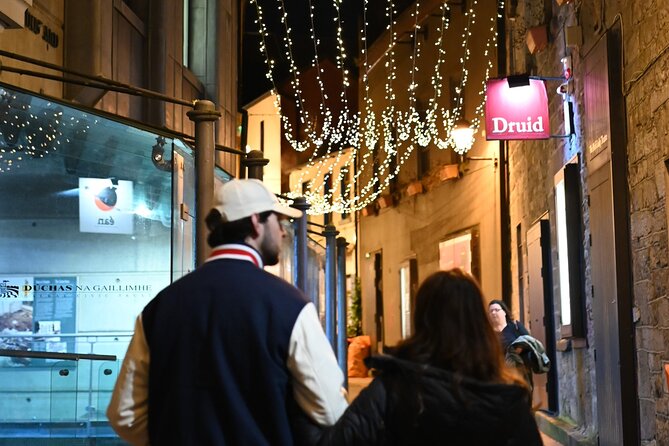
The walk continues into High Street, part of Galway’s Latin Quarter. Here you see the King’s Head Pub, linked by local legend to Oliver Cromwell and the executioner of King Charles I.
Treat that story as a legend, not a settled fact. It is still useful because Galway’s pubs often carry several versions of the past, and the guide helps you separate the tale from the building itself.
You also pass Naughton House, once connected with Richard Martin, known in his younger years as Hairtrigger Dick and later as Humanity Dick. Martin served as an Irish MP in the British Parliament and introduced animal protection laws that helped lead to the creation of the SPCA.
The nearby Lynch memorial stop takes about ten minutes, followed by Quay Street. Quay Street has been a central part of Galway life for centuries and is now lined with pubs, restaurants, cafés, and music venues. The route also points out a medieval castle, the Claddagh Ring Museum, and a building that once housed Galway’s first nightclub.
Quay Street can be busy. That is part of its appeal, but it can make explanations harder to hear and walking slower. If the street is too crowded, the guide may use Kirwan’s Lane instead.
The Claddagh village from Wolfe Tone Bridge
From the Wolfe Tone Bridge, you can look across the River Corrib toward the Claddagh. This old Gaelic settlement sat outside the walled city and was home to a fishing community of about 3,000 people.
The guide explains the role of Galway Hooker boats and how fishermen worked Galway Bay while women sold the catch near the Spanish Parade. The Claddagh ring takes its name from this area, so the earlier jewelry shops now have a stronger connection to the city’s social history.
The view is one of the best chances to pause and take photographs. It also shows that Galway was never only an Anglo-Norman or merchant city. Gaelic life continued beside, and sometimes beyond, the walls.
Spanish Arch and the Hall of the Red Earl
The Spanish Parade once formed part of Galway’s old port. Until around 1660, Galway traded actively with France, Spain, and Portugal. Galley ships brought goods such as wine and spices, helping the city’s merchant families prosper.
The nearby Spanish Arch sits beside the River Corrib. The stop lasts about eight minutes and links the riverfront to Galway’s commercial past.
A few minutes away is the Hall of the Red Earl, the former castle residence of the Norman Richard de Burgo. The site was important until the late 16th century, then disappeared from view for centuries. Archaeologists found the remains during work in the late 1990s.
I particularly like this stop because it gives you something easy to miss on your own. It is not just an old wall or a famous façade. It shows how modern building work can reveal a much older Galway underneath.
Naughton’s Pub, Kirwan’s Lane, and living culture
The route passes Tig Neachtain, often called Naughton’s Pub, in the medieval quarter. The building was once the townhouse of Richard Martin, the same Humanity Dick discussed earlier.
If your group is interested, you can return here for drinks at your own expense. That option works well because the pub is part of the story, not a random refreshment stop. Alcohol is not included, and coffee and tea are also extra.
Kirwan’s Lane offers a short alternative to crowded Quay Street. The lane is named for one of Galway’s Gaelic tribal families and preserves a quieter medieval streetscape. It also marks the former site of Richard Martin’s theatre.
The tour then passes An Taibhdhearc on Middle Street, Ireland’s only Irish-language theatre. Founded as a major cultural project in the early 1920s, it employed Micheál MacLiammóir as its first director and manager from 1928.
The guide also discusses the Augustinian Order, which arrived in Galway in 1500, was banished under Oliver Cromwell, and returned in 1760. You hear about the Druid Theatre Company too, founded by university graduates in Galway in 1975 and linked with writers including Tom Murphy and Martin McDonagh.
These final cultural details prevent the walk from becoming a stone-building inventory. Galway’s identity is still tied to theatre, language, music, and public storytelling.
Abbeygate Street and the final stop
The last scheduled stop is the former cathedral building at the junction of Middle Street and Abbeygate Street Lower. Its Gothic and Tudor Revival style marks a later chapter in the city’s religious architecture.
The building served Galway for many years until the bishop, Dr Michael Browne, judged it inadequate. The stop takes about ten minutes and closes the tour by returning you to the city’s layered architectural story.
The walk ends in Eyre Square, although you can choose to remain in the old town or Latin Quarter with your guide. That is useful if you want to continue with lunch, shopping, the market, or a pub stop rather than retrace the route.
What the $360.93 group price really buys
The price is $360.93 per group, with the stated capacity listed as up to 15 people. Elsewhere, the experience is described as limited to 17 participants, so I would confirm the exact maximum when booking.
For a couple, the cost is high. For a family or group of friends, the value improves quickly. At 10 people, it works out to about $36 per person. At 15, it is about $24 per person for a professional private tour lasting roughly 2 hours 35 minutes.
You are paying for a guide’s time, route planning, local interpretation, and flexibility rather than admission-heavy sightseeing. Most stops are free, and the church offers a discounted follow-up ticket in specific circumstances. If you want a self-guided walk with no fixed cost, you can cover many of these streets alone. The private format earns its price when you want context, questions answered, and a route adjusted to your group.
The tour is booked, on average, 55 days ahead, so popular travel dates may need planning. Confirmation arrives at booking, and free cancellation is available up to 24 hours before the start time. Bad weather can cancel the walk, with a new date or full refund offered.
Who will enjoy this Galway walk?
I would choose this experience for families, first-time visitors, friends traveling together, and anyone who wants Galway explained through stories rather than dates alone. Children can take part, and service animals are allowed.
It also suits people who want practical local advice. One particularly useful strength is the guide’s ability to explain how to reach sights later and point out places where locals eat. That can save you from spending every meal on the most obvious tourist street.
The route may be demanding for some people because it covers many streets and stops over more than two hours. A shorter private city tour is available for people with mobility issues, so ask about that option rather than assuming this longer walk will be comfortable.
Should you book it?
Book this Galway Historic City Tour if you are sharing the cost with family or friends and want a clear introduction to Galway’s medieval center, merchant families, churches, riverfront, and cultural life. The strongest parts are the personal guide, the unusual details at the Hall of the Red Earl, the stories of Lynch’s Castle and the memorial window, and the connection between the Claddagh ring and the old fishing village.
Skip it if you prefer to wander without a schedule, dislike walking in crowded streets, or mainly want extended interior visits. For most groups, though, the price becomes fair when divided among several people, and the private format gives you something a map cannot: a local voice connecting Galway’s scattered clues into one readable story.
FAQ
Where does the Galway Historic City Tour start?
The tour starts at the front entrance of The Hardiman Hotel in Eyre Square, Galway.
Where does the tour end?
The planned end point is Eyre Square. You may also remain in the old town or Latin Quarter with your guide.
How long does the tour last?
The experience lasts approximately 2 hours and 35 minutes.
Is this a private tour?
Yes. Only your group takes part. The price is $360.93 per group, with the capacity stated as up to 15 people, although another description gives a maximum of 17, so confirm the exact group limit when booking.
Is admission included?
The walking tour includes the listed outdoor sights and a visit to St Nicholas’ Collegiate Church. Alcoholic drinks, coffee, tea, and extra gratuities are not included.
Can the tour be changed for my group?
With group agreement, the walking tour can be adapted to individual wishes. A shorter private city tour is also available for people with mobility issues.
Newest in Galway
- Wild Brown Trout fishing. Lough Corrib. French speaking Ghillie/Guide. Full day.★ 5.0 · 2 reviews
- Outdoor Walking Tour in Wonderful Walls of Galway City★ 4.5 · 2 reviews
- Walking the West Quarter of Inishbofin Island, Connemara coast. Self guided.5Hrs★ 5.0 · 1 review
- Private visit in an Irish Castle Home★ 5.0 · 6 reviews
- Tribe Gin School Experience in Galway★ 5.0 · 34 reviews
- Cong The Quiet Man Museum Skip-the-Line Ticket★ 4.5 · 13 reviews
- Walking Tour of The Quiet Man Film Locations in Cong★ 5.0 · 78 reviews
- Transfer – Galway City to Cork City (or reverse) – Premium Sedan★ 5.0 · 1 review
Historical Tours, compared.
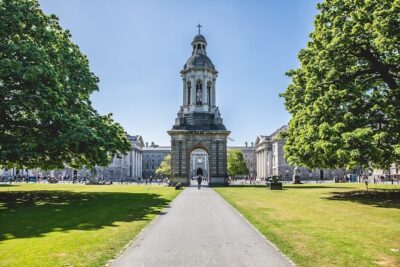
Dublin Historical Centre Food Tour with 8 Food Tastings & Drinks
Read our review →

Historical 2-Hour Guided Walking Tour of Dublin
Read our review →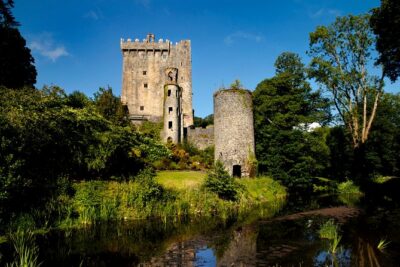
Dublin to Cork, Blarney Castle & Cóbh Heritage Centre by train
Read our review →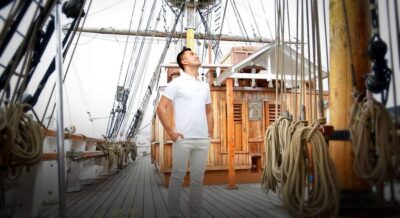
Jeanie Johnston Tall Ship Irish Famine History Tour
Read our review →

Deliciously Dublin: The Artisan Donut Walking & History Tour
Read our review →Browse the lists this tour appears in