
Reviewed · HISTORICAL TOURS
2-Hour Historical Walking Tour from Dublin
Dublin makes more sense when you know its backstory. This affordable walking tour links major sights with the people, conflicts, and decisions that shaped the city. I especially like the small maximum group of 25 and the fact that every guide is a history postgraduate, not simply someone reciting dates from a card.
I also like the timing. At about two hours and priced at $22.98 per person, it gives you a useful first look without taking over your day. The main caution is that this is a serious history tour. Guides such as Eoin, Jody, John, and Daragh are praised for clear storytelling and humor, but one unhappy participant found the political detail too dense and said the tour ran about 30 minutes long.
In This Review
- Key points to know before booking
- Why this is a useful first look at Dublin
- Meeting the guide at Trinity College
- The Bank of Ireland and the politics of power
- Temple Bar beyond the pub signs
- Wood Quay and Viking Dublin
- The Four Courts and the Civil War
- Christ Church Cathedral and the English invasion
- City Hall and Daniel O’Connell
- Dublin Castle and the Dubh Linn
- The guides make or break the experience
- Timing, weather, and physical effort
- Who should book this Dublin walk?
- Final verdict: good value for the right audience
- FAQ
- How long does the Dublin historical walking tour last?
- How much does the tour cost?
- Where does the tour meet?
- Should I wait at the Trinity College gates?
- Where does the tour finish?
- Is the Book of Kells included?
- Is the tour offered in English?
- How large is the group?
- Is the tour suitable for children?
- Can I cancel for a refund?
Key points to know before booking
- Expect real historical detail: The tour covers Dublin from its Viking beginnings through the War of Independence, Civil War, Catholic Emancipation, and modern political questions.
- Start opposite Trinity College: Meet at the Henry Grattan Monument, also called the Grattan statue, on College Green. Do not wait at the Trinity College gates.
- See eight central landmarks: The route includes Trinity College, the Bank of Ireland, Temple Bar, Wood Quay, the Four Courts, Christ Church Cathedral, City Hall, and Dublin Castle.
- Book the Book of Kells separately: The tour discusses this famous manuscript, but admission is not included.
- Wear comfortable shoes and check the forecast: You walk for two hours, often in exposed Dublin weather, with stops for explanations rather than indoor shelter.
- Best for history-minded visitors: It is a strong first activity in Dublin, especially if you want context before exploring museums and historic buildings on your own.
Why this is a useful first look at Dublin
I like starting a city visit with a walk like this because Dublin’s sights can otherwise feel disconnected. Trinity College looks like a grand university, Temple Bar looks like a nightlife district, and Dublin Castle looks like an impressive old government complex. The guide ties those places together.
The route is really about power. You hear how religion shaped politics, how English rule affected the city, how Vikings founded Dublin, how independence split the country, and how public buildings still carry those arguments in stone. That gives you more than a checklist of landmarks.
At $22.98, the tour is good value for a visitor who wants an orientation without paying for several separate admissions. The price covers the guide’s expertise and the walk itself, while the major stops are viewed from public spaces. You are paying for interpretation, not entry tickets.
The format also leaves your afternoon open. You can return to the Book of Kells, enter Christ Church Cathedral, tour Dublin Castle, visit museums, or simply follow up on the subjects that caught your attention.
The tradeoff is pace. Eight stops in roughly two hours means the guide has to keep moving. You will hear a lot, but you will not have long periods to explore each site. Think of this as a city history lesson on foot, not a slow architectural tour with extended interior visits.
More History Tours in Dublin
- Dublin Historical Centre Food Tour with 8 Food Tastings & Drinks
★ 5.0 · 1,718 reviews - Historical 2-Hour Guided Walking Tour of Dublin
★ 4.7 · 865 reviews - Dublin to Cork, Blarney Castle & Cóbh Heritage Centre by train
★ 4.5 · 510 reviews
Meeting the guide at Trinity College
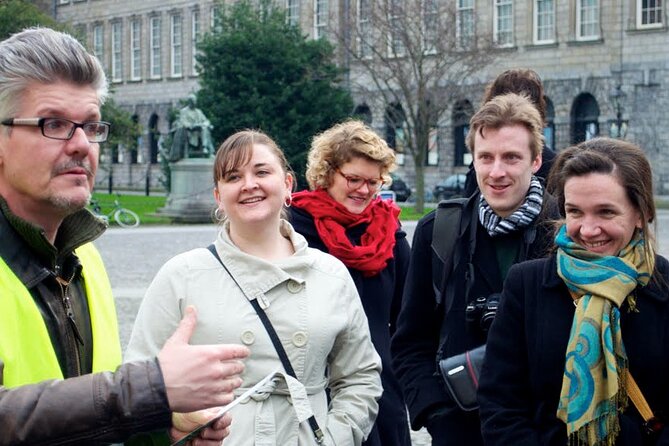
The meeting point is the Henry Grattan Monument on College Green, directly opposite Trinity College’s front gate. This detail matters. One participant waited at the gates and missed the guide, while the tour operator explained that the correct place is the Grattan statue.
Arrive with the meeting point clear on your phone. The tour is offered in English, and a mobile ticket is provided. It is near public transportation, so reaching College Green is straightforward, although the supplied information does not specify particular bus or tram routes.
The opening stop is Trinity College, Ireland’s oldest university, founded in 1592. You enter the campus area with the guide and hear how the university fits into Ireland’s religious and political story.
The Book of Kells is the star object here. It is an eighth-century manuscript containing the four Gospels in Latin, and it is described as Ireland’s most valuable artefact. The tour explains its importance, but entry to the Book of Kells is not included, so plan a separate visit if you want to see the manuscript.
That distinction helps with planning. You can take this walk first, learn why the Book of Kells matters, and then decide if you want to spend more time and money inside. The tour itself allows about 20 minutes at Trinity College, so it gives context rather than a full visit.
The Bank of Ireland and the politics of power
The next stop is the Bank of Ireland, once Ireland’s colonial parliament. Built in 1729, the building represents the period known as Protestant Ascendancy, when political and economic power rested heavily with the Protestant ruling class.
The Act of Union abolished that parliament in 1800. Your guide uses the building to explain how political authority was organized before the union with Great Britain and why the building remains such a strong symbol of that period.
You spend about 10 minutes here. That is enough for the main explanation and a look at the architecture, but not a full examination of the building. The point is the connection between elegant neoclassical design and the political system that financed and used it.
This is where the tour’s approach becomes clear. Buildings are not treated as pretty backdrops. They are evidence of who had power, who was excluded, and how Dublin changed when government moved elsewhere.
Temple Bar beyond the pub signs
Temple Bar is now one of Dublin’s best-known areas, but the tour gives you a less familiar version of it. The narrow streets were once marked for demolition before being repurposed as Dublin’s Cultural Quarter in the 1990s.
That change is worth hearing about because it shows that cities are not fixed. A place now associated with restaurants, pubs, and evening crowds had a very different future planned for it. The guide can help you see the district as an urban planning decision, not just a social stop.
The visit lasts about 10 minutes. You will not receive a long food or nightlife orientation, so do not choose this tour expecting restaurant recommendations or an extended look at Temple Bar’s businesses. Its value is the story of preservation and reuse.
More Walking Tours in Dublin
- Dublin Highlights and Hidden Gems Guided Walking Tour
★ 5.0 · 6,020 reviews - Dublin: Highlights and Hidden Gems Walking Tour
★ 4.9 · 2,140 reviews - 1916 Rebellion Walking Tour
★ 5.0 · 1,605 reviews - 90 Minute Dublin Walking tour and Sightseeing tips
★ 5.0 · 916 reviews
Wood Quay and Viking Dublin
At Wood Quay Amphitheatre, the subject shifts further back in time. Extensive archaeological excavation took place here in the 1980s, revealing evidence of the Viking city founded in AD 840.
This is one of the most important historical connections on the walk. Dublin is not only a medieval English or modern Irish city. Its beginnings also reach back to Viking settlement, trade, and urban life.
The stop lasts about 10 minutes, which makes the guide’s explanation especially useful. Archaeological remains are not always easy to read from the street, and without context you might pass through Wood Quay without realizing what was found below it.
I like this part because it widens the story. The tour does not begin with the English invasion and end with independence. It shows Dublin as a city shaped by several peoples and long periods of change.
The Four Courts and the Civil War
The Four Courts is Ireland’s legal headquarters and one of the most politically charged stops. The building is tied to the Civil War that began in June 1922, when those who supported the Treaty of December 1921 fought those who opposed it.
That Treaty had ended the War of Independence from 1919 to 1921, but it did not end disagreement. The division over the Treaty split the independence movement, and the Four Courts became a major location in the conflict.
You spend about 20 minutes here, one of the longer stops. That makes sense because the story needs more than a date. Your guide explains the relationship between the War of Independence, the Treaty, and the Civil War, helping you understand why independence did not bring immediate unity.
This section is also the clearest warning about the tour’s style. If you want cultural anecdotes and light sightseeing, the political detail may feel heavy. If you want to understand why twentieth-century Irish history contains so many divisions, this is one of the most useful parts of the walk.
Christ Church Cathedral and the English invasion
Christ Church Cathedral is Dublin’s oldest cathedral, dating to 1030. It was rebuilt in stone in the 1170s by Strongbow, the Norman leader connected with the original English invasion of that decade.
The cathedral gives the guide another chance to explain how religion and conquest overlapped. The building is not presented as an isolated church. It is part of the story of Norman power, English influence, and the reshaping of Dublin during the medieval period.
The scheduled stop is about 10 minutes. Entry is not listed as part of the tour, so you should not expect an interior visit as part of the walking experience. If the cathedral interests you, set aside separate time to explore it.
The route information names Christ Church Cathedral as the listed endpoint, but it also includes City Hall and Dublin Castle afterward. Because of that unusual detail, confirm the day’s exact finishing point with your guide. The sites are all in the central area, so the important practical point is that you remain near major sights rather than ending far outside town.
City Hall and Daniel O’Connell
Inside City Hall is a statue of Daniel O’Connell, Dublin’s first Catholic Lord Mayor, elected in 1840. O’Connell led the successful campaign for Catholic Emancipation in 1829, ending anti-Catholic laws. That achievement earned him the name The Liberator.
This is a good example of how the walk connects a person to a place. You are not simply told that O’Connell was important. You see his image in a civic building and learn how religious restrictions affected public life and political participation.
The stop is listed at about 10 minutes. Since the tour includes several major themes in a short time, the guide will focus on the essential story rather than every detail of O’Connell’s career.
This part may appeal to you if you want more than military and constitutional history. It brings the discussion back to civil rights, religion, and the gradual expansion of political life.
Dublin Castle and the Dubh Linn
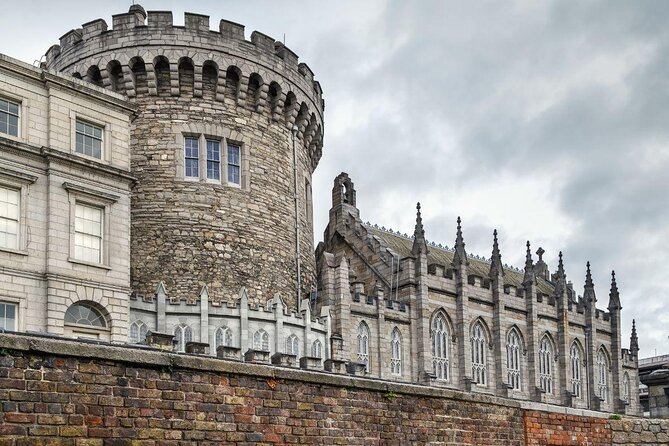
Dublin Castle was originally built by King John in 1204 and served as the seat of British administration until 1922. The site also connects to the Dubh Linn, or Black Pool, from which Dublin gets its name.
The castle is a fitting final historical anchor because it brings several threads together: medieval rule, British administration, and the transfer of power in the twentieth century. You see how the city’s name and government center both connect to the site.
Again, this is an exterior history stop rather than a castle admission. About 10 minutes is allotted, so you will leave with a clear framework and can return later if you want a longer visit.
I find that useful. After hearing the castle’s role in Irish history, you can decide if its rooms and exhibitions deserve a place in your schedule. The walking tour helps you choose rather than asking you to enter every attraction automatically.
The guides make or break the experience
The strongest feature here is the guide. Every guide is a history postgraduate, and that academic background shows in the amount of material covered. But the best comments also praise personality, clear voices, humor, and storytelling.
Eoin is described as entertaining and easy to hear, even during rainy and windy weather. Jody is praised for enthusiasm, acting ability, and a broad account of Irish history from Celtic settlers to modern Brexit. John is noted for explaining how Dublin became what it is today, while Daragh is described as friendly and informative.
That does not mean every guide will use the same style. Some explanations may be lively and funny, while others may lean more heavily into politics and detail. The common thread is serious preparation and a passion for the subject.
You need to pay attention. One participant found the presentation too dense and political, while others appreciated the amount of detail. A teenager enjoyed the tour, but the experience is probably not aimed at young children who need constant movement or entertainment.
The group can include up to 25 people. That is still small enough for a walking tour to feel organized, though it is not a private experience. Stay close to the guide, especially at busy city intersections, and ask questions when there is a pause.
Timing, weather, and physical effort
The advertised duration is about two hours, but several accounts describe the walk lasting longer, including one that reached two and a half hours. If you have a timed lunch, museum booking, or train departure, leave a cushion afterward.
The physical demand is moderate. You walk through central Dublin for the full session, with standing time at each landmark. Comfortable shoes are a must, and the walk is better with clothing suited to rain, cold, and wind. Several people enjoyed it despite freezing or wet weather, but Dublin weather can make a stationary history talk feel longer.
Service animals are allowed. The tour is near public transportation, and participants are expected to have a moderate level of fitness. The information provided does not give specific details about step-free access, seating, or wheelchair suitability, so ask the operator if those issues matter to you.
Who should book this Dublin walk?
Book it if you want a strong historical framework before exploring Dublin independently. It suits adults, older teenagers, history fans, and anyone who wants to understand the links between Viking settlement, English rule, religion, independence, and civil conflict.
It is also a smart choice on the first day of your stay. You get oriented to central Dublin, pass several major sights, and learn which places deserve a return visit. One useful effect of the route is that you can revisit Trinity College, the Four Courts, Christ Church, or Dublin Castle later with more context.
You may want a different tour if your priority is food, music, local shopping, architecture alone, or a relaxed stroll with only brief commentary. This experience is not light sightseeing dressed up as history. It is a history tour that happens to move through Dublin’s streets.
The free cancellation policy is practical: cancel at least 24 hours before the start time for a full refund. Changes or cancellations made within 24 hours are not accepted for a refund.
Final verdict: good value for the right audience
I would recommend this tour to anyone who wants Dublin’s major sights to make political and historical sense. The $22.98 price is modest for a two-hour guided introduction, the route stays central, and the group limit keeps it from becoming an enormous crowd.
Book it early in your stay, bring sturdy shoes, and meet at the Grattan statue rather than the Trinity gates. Choose it for serious storytelling, not a casual wander. If that sounds right, this is an efficient and worthwhile way to get your bearings fast and spend the rest of the day following your own interests.
FAQ
How long does the Dublin historical walking tour last?
The advertised duration is approximately two hours. Some accounts describe the walk lasting closer to two and a half hours, so leave extra time after the scheduled finish.
How much does the tour cost?
The listed price is $22.98 per person.
Where does the tour meet?
The meeting point is the Henry Grattan Monument, also called the Grattan statue, on College Green opposite the front gate of Trinity College Dublin.
Should I wait at the Trinity College gates?
No. The stated meeting point is the Grattan statue opposite the front gate, not the gates themselves.
Where does the tour finish?
Christ Church Cathedral is listed as the endpoint, though the route description also includes City Hall and Dublin Castle after the cathedral. Confirm the exact finishing point with the guide.
Is the Book of Kells included?
No. The tour discusses the Book of Kells, but admission to see it is not included.
Is the tour offered in English?
Yes. The tour is offered in English.
How large is the group?
The maximum group size is 25 people.
Is the tour suitable for children?
The information states that participants should have a moderate level of physical fitness. The detailed historical and political presentation may suit older children and teenagers better than young children.
Can I cancel for a refund?
Yes. You can receive a full refund if you cancel at least 24 hours before the experience start time. Cancellations or changes made less than 24 hours beforehand are not accepted for a refund.
Newest in Dublin
- Wicklow Mountains Private Day Tour including Glendalough★ 5.0 · 7 reviews
- Wicklow: Private Day Tour from Dublin★ 5.0 · 5 reviews
- From Dublin: Powerscourt House, Guinness Lake & Glendalough★ 5.0 · 2 reviews
- Ultimate Dublin Food Tour★ 4.5 · 2 reviews
- Women Of Ireland: Trailblazers & Pioneers★ 5.0 · 4 reviews
- Wicklow tour of Glendalough★ 4.5 · 8 reviews
- Wicklow Mountains & Glendalough Luxury Private Day Tour★ 5.0 · 23 reviews
- Whiskey Tasting Tour of Dublin★ 5.0 · 117 reviews
Historical Tours, compared.

Dublin Historical Centre Food Tour with 8 Food Tastings & Drinks
Read our review →
Historical 2-Hour Guided Walking Tour of Dublin
Read our review →
Dublin to Cork, Blarney Castle & Cóbh Heritage Centre by train
Read our review →
Jeanie Johnston Tall Ship Irish Famine History Tour
Read our review →

Deliciously Dublin: The Artisan Donut Walking & History Tour
Read our review →
Browse the lists this tour appears in