
Reviewed · HISTORICAL TOURS
Galway History Walking tour with Local expert – Private Group
Galway reveals itself one street at a time. This nearly two-hour private walk links medieval lanes, churchyards, theatres, riverside views, and local legends in a compact route through the city center. I like the small private format, which lets you ask questions and adjust the pace, and I like that St Nicholas’ Collegiate Church is part of the experience for qualifying departure times. The main consideration is the weather: Galway rain and wind can make an outdoor history walk less comfortable.
Guide Ger, also called Gerard, brings an easygoing manner and plenty of local detail. He has been praised for explaining Galway’s complicated past in plain language, recommending restaurants and pubs, taking photos, and shaping the route around family interests or personal connections. If you prefer a slow, thoughtful walk to a quick checklist of sights, this tour should suit you well. Some departures require a separate church voucher, so confirm the time when booking.
In This Review
- Five things that make this Galway walk worthwhile
- Starting at Eyre Square with Galway’s fourteen tribes
- Williamsgate Street and the Claddagh connection
- Eglinton Street and a quiet Franciscan burial ground
- Courthouse Square and the River Corrib
- Lynch’s Castle and the story behind the stonework
- Church Lane, Market Street, and St Nicholas’ churchyard
- St Nicholas’ Collegiate Church, the tour’s key indoor stop
- The Latin Quarter, King’s Head, and Galway’s old port
- The Hall of the Red Earl and Galway’s medieval foundations
- Druid Theatre and An Taibhdhearc
- Abbeygate Street and the Augustinian connection
- How the private format affects the experience
- Pace, weather, and mobility
- Who should book this Galway history walk?
- Should you book it?
- FAQ
- Where does the Galway walking tour start?
- Where does the tour end?
- How long does the tour last?
- How much does the private tour cost?
- Is the tour private?
- Is St Nicholas’ Collegiate Church included?
- What language is the tour offered in?
- Is transportation included?
- Can the tour be shortened for someone with mobility issues?
- Can I cancel for a full refund?
Five things that make this Galway walk worthwhile
- St Nicholas’ Collegiate Church included: See Ireland’s largest medieval church still in continuous use, with a guide to explain its past.
- Local stories beyond the main sights: Hear the tale of Mayor Lynch, learn about Nora Barnacle, and explore Galway’s old merchant families.
- A genuinely private group: The advertised rate of $150.60 covers up to 13 people, making it good value for families and small groups.
- A route through overlooked corners: Church Lane, the Franciscan graveyard, the Hall of the Red Earl, and An Taibhdhearc add texture beyond the usual Latin Quarter stroll.
- A flexible pace: Ger has adapted walks for family interests, food questions, ancestry discussions, weather, and mobility needs.
- A useful first-day orientation: The route helps you understand Galway’s layout before you explore its pubs, restaurants, shops, and music venues on your own.
Starting at Eyre Square with Galway’s fourteen tribes
Meet your guide at the front entrance of The Hardiman Hotel, beside Eyre Square. This is a practical starting point, since the square is central and easy to reach by public transport.
The first part of the walk explains Galway through its civic symbols. You’ll see the old Browne Doorway, the banners of the Tribes of Galway, the John F. Kennedy memorial, the Quincentenary Fountain, and the O’Conn aire statue. These details help explain how Galway developed from a medieval port into the city you see today.
The banners are especially useful for setting the scene. Galway’s leading merchant families shaped trade and local politics for centuries, and the city’s identity still reflects those old connections. A guide can make these names and symbols less abstract than they would be on a plaque.
Eyre Square is also where you can ask for practical advice. Ger has recommended restaurants, pubs, and food stops along the way, including options for fish and vegetarian meals. I would use this early portion to mention anything you particularly want from the rest of your Galway stay.
More History Tours in Galway
- Galway: Dark History Guided City Walking Tour
★ 4.8 · 236 reviews - The Dark History Tour of Galway City
★ 5.0 · 146 reviews - Galway City on Foot with Seán: Stories, History, Local Tips, Chat and More..
★ 5.0 · 64 reviews
Williamsgate Street and the Claddagh connection
From Eyre Square, the group moves onto Williamsgate Street. The Browne Thomas building gives the route an architectural point of interest, while nearby jewellers connect the walk to Galway’s best-known piece of traditional jewelry, the Claddagh ring.
You may also stop at the Oscar Wilde statue if time allows. Estonia gave the statue to Ireland in 2004, a small but memorable detail that shows how Galway’s public spaces collect stories from outside the city as well as within it.
This section is short, so do not expect a long shopping stop or a detailed jewelry lesson. Its value is in showing how Galway’s central streets mix commerce, architecture, literature, and local tradition within a few minutes of walking.
Eglinton Street and a quiet Franciscan burial ground
The route turns down Eglinton Street and passes the Franciscan Friary church. Behind it is a small graveyard that was used for burials during the mid-seventeenth and early eighteenth centuries.
This is the sort of stop that can easily be missed when you are following the main shopping streets. It also changes the mood of the walk. Galway is often associated with pubs, music, and colorful storefronts, but older religious sites reveal the city’s quieter side.
The graveyard is not presented as a major sightseeing attraction. Instead, it adds context to the city’s former religious life and shows how close Galway’s old burial grounds are to its modern streets.
Courthouse Square and the River Corrib
Courthouse Square once contained two important courthouses, one serving the county and one serving the city. One remains, with the Town Hall Theatre opposite.
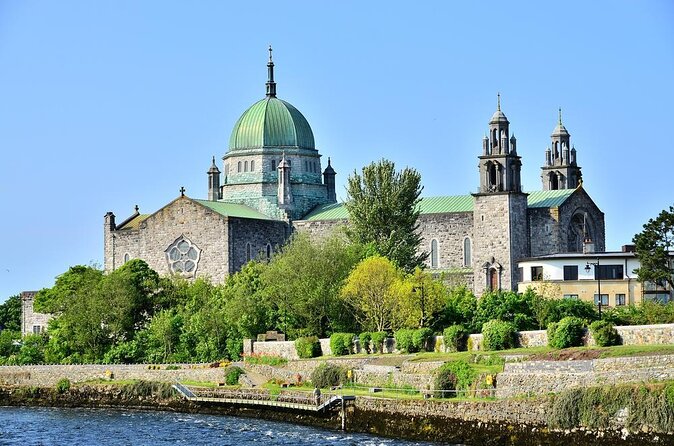
From here, the walk reaches the River Corrib and pauses on the modern pedestrian bridge. You’ll get a view toward Galway Cathedral and the Franciscan Chapel, along with a reminder that the city’s old core is closely tied to the river.
The cathedral is described as Europe’s newest stone cathedral. It is not an ancient medieval building, but its stone construction and prominent position make it an important part of Galway’s modern religious architecture. The bridge provides a useful pause in the walking route and a chance to look outward rather than only at walls and doorways.
More Walking Tours in Galway
- The Welcome to Galway Walking Tour
★ 5.0 · 427 reviews - Galway: Welcome to Galway Walking Tour
★ 4.8 · 338 reviews - Walking and Tasting Tour of Galway City
★ 5.0 · 283 reviews - The Legendary Walking Tour of Galway
★ 5.0 · 230 reviews
Lynch’s Castle and the story behind the stonework
The route returns along Galway’s popular River Walk before reaching Lynch’s Castle. This is the finest surviving town-castle in Ireland, and it once belonged to the powerful Lynch clan.
The building is easy to overlook because it sits within a busy city intersection. Your guide points out its crests and roundels, helping you read the façade rather than simply photograph it. Galway’s old merchant families used buildings like this to display status, family identity, and political strength.
Lynch’s Castle is also the setting for Galway’s most famous grim legend. The Lynch Memorial window refers to the story of Mayor Lynch hanging his own son at this location. The tale is dramatic, but a good guide should also explain it as legend rather than present every detail as settled fact.
I particularly like the way this stop connects architecture with human drama. You are not just seeing an attractive old building. You are hearing how power, justice, family, and public memory became attached to one address.
Church Lane, Market Street, and St Nicholas’ churchyard
The walk turns into Church Lane, once called Dead Man’s Lane because funerals passed through it toward an old graveyard. From there, the route continues past St Nicholas’ churchyard and through Market Street.
This stretch gives you a better sense of medieval Galway’s street plan. Narrow lanes were not designed for sightseeing. They were working routes connecting homes, shops, churches, and burial grounds. Their names often preserve a practical history that modern street signs do not explain.
The pace here is deliberately unhurried. Ger has been praised for taking time with questions and not rushing people from one location to the next. That matters in a place like Galway, where the meaning of a lane may take longer to explain than the lane takes to walk.
St Nicholas’ Collegiate Church, the tour’s key indoor stop
For the 10 a.m. and 1 p.m. tour times, the experience includes a voucher toward a visit to St Nicholas’ Collegiate Church. The church is the largest medieval church in Ireland still in continuous use.
It began as a Catholic church and now functions as a Protestant church, reflecting the religious changes that shaped Ireland. Inside, you’ll encounter a building with much more depth than its modest time allocation suggests. The guide explains the church’s place in Galway’s past, including the tradition that Christopher Columbus worshipped here before his voyage of discovery in 1477.
The voucher is a valuable inclusion because it gives you an indoor break if the weather turns wet. It also adds real substance to a walking tour that could otherwise rely mainly on exterior views.
Pay close attention to the departure time. The inclusion is specifically stated for the 10 a.m. and 1 p.m. tours, so do not assume every start time provides the same church arrangement. The church also offers its own guided tours on selected weekdays, with times listed as Monday through Friday at 11 a.m. and 2 p.m., plus Wednesday at noon and 3 p.m. The voucher and those church tours are not necessarily the same thing, so check the day’s details before planning around them.
The Latin Quarter, King’s Head, and Galway’s old port
High Street brings you into Galway’s Latin Quarter. This is one of the city’s most recognizable areas, with pubs, shops, and historic façades close together.
The King’s Head Pub is tied to a colorful story involving Oliver Cromwell and the executioner of King Charles I. As with the Lynch story, the tale works best when you enjoy it as local tradition while keeping an open mind about the historical record.
You’ll also pass Naughton House, once owned by Humanity Dick Martyn, an Irish member of the British Parliament. These names help give the Latin Quarter a social history. The buildings were not simply decorative backdrops. They belonged to people involved in trade, public life, politics, and the often-complicated relationship between Ireland and Britain.
The Spanish Parade opens the route toward the water. Before 1840, this area formed part of Galway’s old port. Galleys from Spain arrived with wine and spices for local merchant families, linking Galway to wider European trade.
The nearby Spanish Arch is the obvious landmark, but the open space around it is just as important. It helps you picture how goods, ships, merchants, and customs once shaped this part of the city. I would listen closely here if you are interested in Galway’s international connections.
The Hall of the Red Earl and Galway’s medieval foundations
The walk loops back toward the Hall of the Red Earl, the former castle residence of the Norman Richard de Burgo. It remained important until the late sixteenth century, then disappeared from view for centuries.
Archaeologists uncovered the ruins in the late 1990s. That discovery gives this stop unusual appeal. You are looking at a medieval site that was not always visible or understood by people passing through the city.
The Hall of the Red Earl helps balance the tour’s better-known buildings. Lynch’s Castle still rises above a street corner, while this older site survives as archaeological remains. Together, they show how much of Galway’s medieval past is still present in different forms.
Druid Theatre and An Taibhdhearc
Galway is not only a city of medieval churches and merchant houses. It is also an important center for Irish theatre.
The Druid Theatre Company was founded by university graduates in 1975. Its work has been closely linked with writers Tom Murphy and Martin McDonagh, and many well-known Irish actors and directors have worked with the company.
The route then continues up Middle Street past An Taibhdhearc, Ireland’s only Irish-language theatre. It began as a major cultural project in the early 1920s, after Ireland became a Free State. Micheál MacLiammóir served as its first director and manager from 1928.
These stops add modern cultural life to the older historical material. If your interests extend beyond castles and churches, this portion helps explain why Galway has such a strong reputation for theatre and the arts.
Abbeygate Street and the Augustinian connection
Near the end of the walk, the guide explains the arrival of the Augustinian Order in Galway in 1500. The order established an abbey in the Forthill area, was banished for a period by Oliver Cromwell’s English army, and returned in 1760 to establish the building connected with this part of the route.
The final stop is the former cathedral building at Middle Street and Abbeygate Street Lower. Its Gothic and Tudor Revival design gives it a different look from the medieval structures seen earlier.
The building served for many years but was considered inadequate by Galway bishop Dr. Michael Browne in 1957. This is a useful closing detail because it shows that historic buildings are not frozen in time. They are altered, replaced, repurposed, and judged according to the needs of each generation.
How the private format affects the experience
The advertised price is $150.60 per group of up to 13 people. For one or two people, that is a substantial outlay compared with a large public walk. For a family or group of friends, the calculation changes quickly. A full group pays roughly $11.60 per person, before any gratuity, which makes the private arrangement quite good value.
The private format is the biggest reason to choose this tour. You can ask about family roots, Gaelic words, architecture, food, pubs, or local writers without worrying about holding up a large crowd. Ger has adjusted routes for daughters, single participants, family interests, and personal ancestry questions.
There is one important practical warning. A private booking does not guarantee that every departure will remain tiny under every circumstance. One reported problem involved a group of ten being combined with another booking after the company was short a guide. The operator explained the change at the start, but the result was harder to hear in windy conditions. If privacy is essential, confirm the group arrangement shortly before the walk.
The tour lasts about one hour and 55 minutes. That is long enough to cover a broad slice of central Galway, but not long enough for extended interior visits at every stop. Most locations are explained from the street, with St Nicholas’ Church providing the main included indoor visit.
Pace, weather, and mobility
This is a city walk, so wear comfortable shoes and expect uneven streets, frequent pauses, and weather exposure. The experience requires good weather and may be canceled by the operator in poor conditions. In that case, you receive the choice of another date or a full refund.
Rain has interrupted some walks, but the indoor church visit can help. Still, do not treat the church as shelter for the entire experience. Most of the route takes place outdoors.
A shortened version can be offered to people with mobility issues. The tour team also has emergency plans, and service animals are allowed. Since the route covers many historic streets and the experience is not described as fully step-free, explain your needs when booking and ask what version of the route will work best.
Transportation to the meeting point is not included. You make your own way to The Hardiman Hotel at Eyre Square, and the walk ends back there. Accommodation, meals, coffee, tea, alcohol, personal expenses, and gratuities are also separate.
Who should book this Galway history walk?
I would choose this tour if you want a clear introduction to Galway before spending the rest of your stay exploring alone. It is especially well suited to:
- Families who want a flexible pace and room for questions
- Small groups who can share the fixed price
- History fans interested in medieval Galway, religion, trade, and local legends
- People curious about Irish theatre, language, and literary connections
- Visitors who want food, pub, and sightseeing suggestions from a local guide
- Anyone who prefers a calm walk over a fast-moving group tour
It may be less suitable if you want a highly visual tour with long visits inside many buildings, or if you dislike walking in uncertain weather. The route covers a lot of ground in under two hours, so the experience is an overview with detail, not a full study of every site.
Should you book it?
Book this Galway walking tour if you value personal attention and local storytelling more than a bargain group outing. The strongest features are the adaptable private format, Ger’s friendly delivery, the useful city orientation, and the chance to see places such as the Hall of the Red Earl, Church Lane, and An Taibhdhearc.
For the best value, bring a group close to the 13-person limit and select a 10 a.m. or 1 p.m. departure if St Nicholas’ Church is important to you. Confirm the church voucher, group size, and mobility needs in advance.
I would skip it only if your schedule is too tight for nearly two hours on foot or if heavy rain is likely. For most small groups spending time in Galway, this is a thoughtful way to understand the city before its streets become familiar.
FAQ
Where does the Galway walking tour start?
The tour starts at the front entrance of The Hardiman Hotel in Eyre Square, Galway, at H91 NFD2.
Where does the tour end?
The activity ends back at the meeting point at The Hardiman Hotel.
How long does the tour last?
The tour lasts approximately 1 hour and 55 minutes.
How much does the private tour cost?
The listed price is $150.60 per group, for up to 13 people.
Is the tour private?
Yes. Only your group participates in the private activity.
Is St Nicholas’ Collegiate Church included?
A voucher toward a visit to St Nicholas’ Church is included for the 10 a.m. and 1 p.m. tours. Confirm the arrangement for your chosen departure time.
What language is the tour offered in?
The tour is offered in English.
Is transportation included?
No. Transportation to and from the meeting point is not included, and you make your own way to The Hardiman Hotel.
Can the tour be shortened for someone with mobility issues?
Yes. A shortened version can be offered to people with mobility issues. Contact the tour provider with your requirements.
Can I cancel for a full refund?
Yes. You can cancel at least 24 hours before the start time for a full refund. Changes or cancellations made less than 24 hours before the start time are not accepted for a refund. If the operator cancels because of poor weather, you receive another date or a full refund.
Newest in Galway
- Wild Brown Trout fishing. Lough Corrib. French speaking Ghillie/Guide. Full day.★ 5.0 · 2 reviews
- Outdoor Walking Tour in Wonderful Walls of Galway City★ 4.5 · 2 reviews
- Walking the West Quarter of Inishbofin Island, Connemara coast. Self guided.5Hrs★ 5.0 · 1 review
- Private visit in an Irish Castle Home★ 5.0 · 6 reviews
- Tribe Gin School Experience in Galway★ 5.0 · 34 reviews
- Cong The Quiet Man Museum Skip-the-Line Ticket★ 4.5 · 13 reviews
- Walking Tour of The Quiet Man Film Locations in Cong★ 5.0 · 78 reviews
- Transfer – Galway City to Cork City (or reverse) – Premium Sedan★ 5.0 · 1 review
Historical Tours, compared.

Dublin Historical Centre Food Tour with 8 Food Tastings & Drinks
Read our review →

Historical 2-Hour Guided Walking Tour of Dublin
Read our review →
Dublin to Cork, Blarney Castle & Cóbh Heritage Centre by train
Read our review →
Jeanie Johnston Tall Ship Irish Famine History Tour
Read our review →

Deliciously Dublin: The Artisan Donut Walking & History Tour
Read our review →Browse the lists this tour appears in