
Reviewed · WALKING TOURS
Dublin: Hidden Gem Walking Tour with Local Guide
Tallaght has more stories than its reputation suggests. This two-hour walk with local guide Sophie links ancient monastic life, Irish writers, wartime reporting, aviation, industry, and modern urban growth in a part of Dublin many visitors skip. I like the focus on people such as Katharine Tynan, William Howard Russell, and Alice Furlong, and I like that the tour ends with a few words of Irish in Tallaght Village. The main drawback is that much of the route takes place around roads, retail areas, and modern streets rather than grand monuments.
You pay about $18.05 per person for a small group of no more than 12 people, with no admission fees along the way. That is a strong price for two hours of local storytelling, especially if you want a side of Dublin shaped by ordinary communities, industry, language, and rapid change rather than the usual city-center sights.
In This Review
- Six reasons this Tallaght walk is worth your time
- Why Tallaght makes an unusual Dublin walking tour
- Kingswood and the first chapters of Tallaght
- Katharine Tynan at Whitehall
- William Howard Russell and the birth of war reporting
- Oisín, Irish mythology, and the Dublin Mountains
- Tallaght Aerodrome, Urneys, and Jacob’s
- Tallaght’s rapid urban growth in the 1970s and 1980s
- St Maelruain’s and Tallaght’s monastic roots
- Alice Furlong and the Irish language
- The Fenian Rising in Tallaght Village
- Cottages, the steam tramway, and a few words of Irish
- What the $18.05 price really gets you
- Who will enjoy this walk most
- Should you book the Tallaght Hidden Gem Walking Tour?
- FAQ
- Where does the tour begin?
- Where does the tour finish?
- How long does the walking tour last?
- What is the price?
- How large is the group?
- What language is the tour offered in?
- Are admission tickets included?
- Is a mobile ticket available?
- Are service animals allowed?
- What happens if bad weather cancels the tour?
- Can I cancel for a full refund?
Six reasons this Tallaght walk is worth your time
- Katharine Tynan’s former home: Learn about the writer’s friendships with W.B. Yeats and George William Russell, known as AE.
- William Howard Russell’s Tallaght beginnings: Follow the early life of one of the first major war correspondents.
- A bilingual Irish legend: Hear Oisín in the Land of Youth in Irish and English with the Dublin Mountains in view.
- Tallaght’s lost industries: Explore the old aerodrome and the local story of Urneys Chocolates and Jacob’s.
- Alice Furlong remembered: Visit the poet’s grave and hear her work in Irish with English translations.
- A local finish: End in Tallaght Village, beside a bilingual café, with a few basic Irish phrases to use.
Why Tallaght makes an unusual Dublin walking tour
Most first-time visitors stay close to Dublin’s Georgian streets, museums, pubs, and riverfront. This walk takes you southwest to Tallaght, a place that grew from a rural settlement and monastic center into one of Ireland’s largest urban areas within only a few decades.
That change gives the tour its central theme. You are not just moving from one old building to another. You are tracing how fields, estates, factories, transport links, housing, and schools reshaped a community during the 1970s and 1980s.
I find that kind of story especially useful because it adds social context to Dublin. Tallaght’s growth took place during years of high unemployment and heavy emigration in Ireland. The tour shows how the area changed during that difficult period and how it continued to develop into the Tallaght you see today.
The group size matters here. With a maximum of 12 people, Sophie can keep the talk conversational and respond to questions. The walking pace also allows time for photographs, letters, poems, and historical images to be brought into the story rather than simply naming dates and buildings.
More Walking Tours in Dublin
- Dublin Highlights and Hidden Gems Guided Walking Tour
★ 5.0 · 6,020 reviews - Dublin: Highlights and Hidden Gems Walking Tour
★ 4.9 · 2,140 reviews - 1916 Rebellion Walking Tour
★ 5.0 · 1,605 reviews
Kingswood and the first chapters of Tallaght
The walk begins in Kingswood Heights, near Kilnamanagh. The opening stop is brief, but it gives you a basic introduction to Tallaght and its place in ancient Irish history.
This is a good way to begin because the tour does not treat modern Tallaght as an isolated suburb. You start by considering the older roots of the area before moving into its literary and industrial past.
The first stops are not presented as ticketed attractions. They are street-level places connected to the stories being told. That means you should expect interpretation and conversation rather than formal interiors or preserved exhibits.
Katharine Tynan at Whitehall
One of the strongest early sections focuses on Katharine Tynan and the former residence known as Whitehall. Tynan was a major literary figure whose life connected Tallaght with the Irish and English literary circles of her time.
You hear about her own writing and her friendships with W.B. Yeats and George William Russell, the writer and artist often known by the initials AE. Letters from Tynan to Yeats and Russell are part of the presentation, which gives the stop a more personal feel than a standard biography.
This part will suit you if you enjoy literary connections but do not want a lecture that stays safely inside Dublin’s famous central landmarks. Tynan’s home helps show how cultural life extended beyond the city center.
The stop lasts about 15 minutes. That is enough time for a focused introduction, though anyone hoping to explore Whitehall itself should note that the tour examines the former residence from outside.
William Howard Russell and the birth of war reporting
At Belgard Road, Sophie turns to William Howard Russell, who was born in Jobstown, Tallaght. Russell became one of the first famous war correspondents and spent much of his career reporting for The Times.
His working life carried him through major events. The talk covers his reports on Daniel O’Connell’s meetings, the Great Famine in Ireland, the Crimean War, and the American Civil War. His friendship with Charles Dickens adds another literary link to the route.
Writings and letters from Russell help make this section more direct. Instead of hearing only about a distant public figure, you get a sense of how he described the events he witnessed.
This is a particularly useful stop for anyone interested in journalism, politics, or the way news was reported before modern broadcast media. It also makes Tallaght feel connected to international events, not simply local ones.
The stop takes about 10 minutes, so the story is selective. You will receive a compact portrait rather than a full biography.
Something completely different for another day:
- Dublin to Cliffs of Moher, including Wild Atlantic Way and Galway
★ 5.0 · 23,331 reviews - From Dublin: Cliffs of Moher, Burren & Galway City Day Tour
★ 4.8 · 18,888 reviews - Dublin: Guinness Storehouse Entry Ticket
★ 4.6 · 16,863 reviews - Dublin to Cliffs of Moher, Burren, Wild Atlantic Way, Galway Tour
★ 5.0 · 12,924 reviews
Oisín, Irish mythology, and the Dublin Mountains
The next stop adds a very different note. Sophie gives a bilingual telling of Oisín in the Land of Youth, known in Irish as Oisín i dTír na nÓg.
You hear the legend in Irish and English, then learn how it connects with the Dublin Mountains visible from the area. That view gives the myth a physical setting. The mountains are not just scenery in the background, they help connect an old Irish story with the place where you are standing.
This is one of the most appealing parts of the tour for anyone curious about the Irish language. You do not need prior Irish to follow the story, since an English version is included.
The stop lasts about 10 minutes. It is a short introduction, not a full course in Irish mythology, but it breaks up the modern streets and shows how language, legend, and place can work together.
Tallaght Aerodrome, Urneys, and Jacob’s
At Belgard Retail Park, the tour turns toward aviation and industry. The area once held Tallaght Aerodrome, built on land connected with Katharine Tynan’s father.
The aerodrome played a role during the First World War, the Irish War of Independence, and the Irish Civil War. A poem by Tynan connected with this development is also shared, bringing the literary and local stories back together.
From there, the focus shifts to the Gallagher family and Urneys Chocolates. The brand occupied an important place in Irish food manufacturing and remained associated with Tallaght for many decades before closing in 1980.
For many people in Ireland, Urneys carries a strong sense of childhood and local nostalgia. The tour also explains how the brand continues to live on, even though the Tallaght factory is gone.
Jacob’s is another part of the industrial story. Its presence in Tallaght helps show how businesses shaped employment, identity, and the physical growth of the area.
This 15-minute section may be the best example of what makes the walk different from a standard sightseeing tour. You are not simply looking at an old church or monument. You are learning how factories and businesses changed daily life.
The drawback is that a retail park is not a picturesque stop. You should come for the story, not for a preserved aerodrome or a chocolate museum.
Tallaght’s rapid urban growth in the 1970s and 1980s
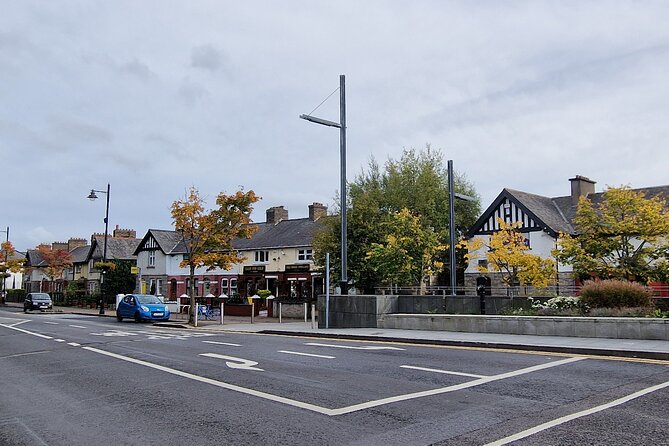
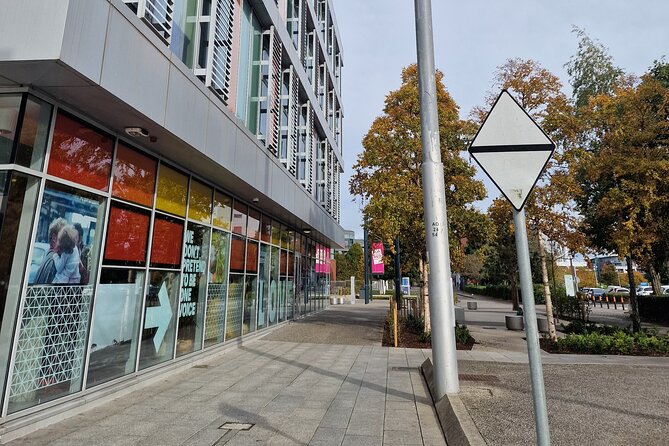
At TU Dublin’s Tallaght Campus, Sophie explains how the area changed from a rural community into one of Ireland’s largest urban centers.
During the 1980s, Tallaght was among the fastest-growing urban centers in Western Europe. That growth brought new homes, roads, schools, businesses, and public services, but it also created pressure for a community changing at great speed.
The tour places this transformation against Ireland’s economic difficulties, including high unemployment and emigration. That context matters. Tallaght’s story is not simply one of expansion. It is also about how people adjusted to rapid development during a period when opportunities at home were often limited.
You will spend about 15 minutes here. The stop works best if you are interested in urban change and local communities. It may feel less rewarding if you only want ancient sites, but it adds a useful modern chapter to the older stories from the first half of the walk.
St Maelruain’s and Tallaght’s monastic roots
The route then reaches St Maelruain’s Church of Ireland. The church occupies ground linked to a former monastery that once held major importance in early Irish history.
Tallaght and Finglas were known as the two eyes of Ireland because of the significance of their monasteries. Sophie explains the life of St Maelruain and how the present church came into being.
This short five-minute stop gives you a sense of how old Tallaght’s religious foundations are. It also changes the rhythm of the walk. After streets shaped by industry and housing, you are brought back to the early medieval past.
The church grounds also provide the setting for the next literary story, making this more than a quick photo stop.
Alice Furlong and the Irish language
Alice Furlong is buried at St Maelruain’s, and the tour brings attention to a writer whose memory had faded from public view until fairly recently.
Furlong was one of the founding members and vice-presidents of Inghinidhe na hÉireann, or Daughters of Ireland. She was also a poet, writer, and advocate for the Irish language, with a strong connection to Tallaght.
Sophie shares examples of Furlong’s poetry in Irish and English. Professional English translations are provided for the Irish-language pieces, so you can follow the meaning while also hearing the original language.
This 15-minute stop is one of the most distinctive on the route. It combines women’s history, literature, Irish cultural activism, and local identity in one place.
I especially like that the tour does not limit Irish history to famous political leaders. Furlong’s story shows how cultural work and language advocacy also shaped the country’s national movement.
The Fenian Rising in Tallaght Village
In Tallaght Village, a plaque marks the Fenian Rising of 1867. Sophie uses it to explain the period and Tallaght’s role in the events.
The stop also includes writings by Charles Dickens about this part of Irish history. That connection gives you another link between local events and well-known literary figures.
This is a 10-minute stop, so expect a clear outline rather than a detailed military account. Its value lies in showing that Tallaght was involved in national political events long before the modern town took shape.
The village setting helps pull together several earlier themes: local people, national change, outside observers, and the way history can disappear beneath ordinary streets.
Cottages, the steam tramway, and a few words of Irish
The tour ends in the heart of Tallaght Village, where you see cottages designed by architect Thomas Joseph Byrne. Sophie also talks briefly about the Dublin and Blessington Steam Tramway, which ran through the area before closing in 1932.
The final 20 minutes are a fitting close because they connect architecture, transport, and language. The tramway helps explain how Tallaght related to Dublin and nearby areas before modern road networks transformed movement.
You then learn some basic Irish and hear a short explanation of the language’s place in Ireland today. The tour finishes beside a bilingual Irish and English café, where you are welcome to use your new phrases.
That café is not included as a formal tasting or meal stop, so plan to pay for anything you order. Still, ending there gives the tour a friendly local finish rather than leaving you at an anonymous roadside.
What the $18.05 price really gets you
At about $18.05, this is inexpensive for a guided two-hour walk with a small group. There are no entrance fees, but that does not reduce the amount of material covered.
You are paying for local research, storytelling, letters, poems, historical photographs, and the ability to connect several periods of Tallaght’s past. The value is strongest if you enjoy people and ideas more than polished attractions.
The price is less compelling if you expect a major monument, museum admission, or a highly scenic route from start to finish. This is a neighborhood walk, and some sections pass through modern urban settings.
The tour is offered in English and uses mobile tickets. It is generally suited to most participants, and service animals are allowed. Since the experience requires good weather, wear practical clothing and shoes suited to two hours on foot.
The meeting point is in Kingswood, Kilnamanagh, Dublin. The walk ends in Tallaght Village at R819. Since the start and finish are in different parts of Tallaght, check your transport plan before arriving. The tour is near public transportation, but the supplied details do not specify a particular bus or tram route.
Who will enjoy this walk most
I would choose this tour if you want to see a less familiar side of Dublin and are happy to trade grand façades for local stories.
It suits:
- People interested in Irish literature and cultural history
- Visitors who want to hear Irish spoken with English explanations
- Dublin residents curious about Tallaght’s past
- Anyone interested in urban growth, industry, and community change
- Visitors who enjoy small-group tours and informal conversation
- History fans who like links between local places and national events
It may not suit you if you want a central Dublin route, indoor attractions, or a walk built around photogenic landmarks. The modern parts of Tallaght are part of the point, but they may feel plain beside Dublin’s historic core.
The guide’s style is a major part of the experience. Sophie is described as friendly, multilingual, and comfortable answering questions. The strongest praise focuses on her local knowledge and her ability to bring overlooked people and places into view.
Should you book the Tallaght Hidden Gem Walking Tour?
Book it if you want an affordable, personal introduction to Tallaght that goes well beyond a quick look at modern Dublin. The strongest reasons are the unusual subjects: Katharine Tynan’s literary circle, William Howard Russell’s reporting career, Alice Furlong’s poetry, the Tallaght Aerodrome, Urneys Chocolates, and the area’s rapid urban growth.
I would be especially keen to book this early in a Dublin stay if I wanted context for the wider region. It is usually reserved about 28 days ahead, so do not assume you can leave it until the last morning.
Skip it if you need a fully scenic walk or a tour packed with interiors and formal sights. But if you value local voices, Irish culture, and the stories found beyond the usual center, this two-hour outing offers a lot for the price.
FAQ
Where does the tour begin?
The tour begins in Kingswood, in the Kilnamanagh area of Dublin, County Dublin.
Where does the tour finish?
It finishes in Tallaght Village on R819, beside a bilingual Irish and English café.
How long does the walking tour last?
The tour lasts approximately two hours.
What is the price?
The listed price is $18.05 per person.
How large is the group?
The tour has a maximum of 12 participants.
What language is the tour offered in?
The tour is offered in English. Irish is also used during the bilingual legend, poetry sections, and the closing language introduction, with English explanations and translations provided where stated.
Are admission tickets included?
The listed stops have free admission, and the tour includes the services of a local guide. No separate attraction admission is specified.
Is a mobile ticket available?
Yes. The experience provides a mobile ticket.
Are service animals allowed?
Yes, service animals are allowed.
What happens if bad weather cancels the tour?
Because the experience requires good weather, a cancellation caused by poor weather offers you a different date or a full refund.
Can I cancel for a full refund?
Yes. You can cancel at least 24 hours before the local start time for a full refund. Cancellations or changes made less than 24 hours before the start time are not refunded or accepted.
Newest in Dublin
- Wicklow Mountains Private Day Tour including Glendalough★ 5.0 · 7 reviews
- Wicklow: Private Day Tour from Dublin★ 5.0 · 5 reviews
- From Dublin: Powerscourt House, Guinness Lake & Glendalough★ 5.0 · 2 reviews
- Ultimate Dublin Food Tour★ 4.5 · 2 reviews
- Women Of Ireland: Trailblazers & Pioneers★ 5.0 · 4 reviews
- Wicklow tour of Glendalough★ 4.5 · 8 reviews
- Wicklow Mountains & Glendalough Luxury Private Day Tour★ 5.0 · 23 reviews
- Whiskey Tasting Tour of Dublin★ 5.0 · 117 reviews
Walking Tours, compared.
Dublin Highlights and Hidden Gems Guided Walking Tour
Read our review →
90 Minute Dublin Walking tour and Sightseeing tips
Read our review →

Historical 2-Hour Guided Walking Tour of Dublin
Read our review →
Dublin Traditional Irish 3 Course Meal Walking Tour with Local
Read our review →
Browse the lists this tour appears in