

Reviewed · WALKING TOURS
Dublin Walking Hibernoceltic Tours
Dublin’s past is tucked around every corner. I like the way Hibernoceltic Tours links major sights such as Dublin Castle with quieter medieval remains, and I especially like the small-group limit of 15 people, which should allow room for questions. The main drawback is that the advertised duration can be confusing: the full outing is about 2 hours 40 minutes, but only around 1 hour 10 minutes is guided touring, with the rest taken up by walking and travel.
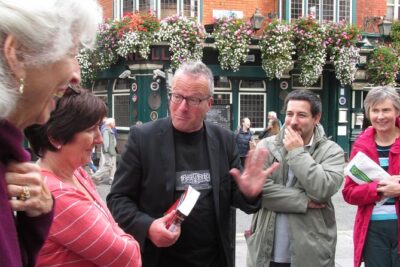
The experience is led by Barry OBrien, also known as Finbarr Barry. His warm manner, generous use of time, and gift for storytelling earned especially strong praise. You should also know that Hibernoceltic offers several history themes, including Viking and Medieval, Famine, Georgian, and Revolutionary routes, so the exact stops depend on the tour you book.
In This Review
- Key points at a glance
- How the different Hibernoceltic routes work
- Dublin Castle and the city’s medieval foundations
- St. Audoen’s Church and the last medieval gateway
- Dame Street and the painful story of the Famine
- Trinity College, Leinster House, and Georgian Dublin
- O’Connell Street and the Revolutionary Tour
- Tenement life and James Joyce’s Dublin
- Barry OBrien’s guiding style
- Is $30.23 a fair price?
- Who should book this Dublin walk?
- Final verdict: choose your history, then book
- FAQ
- Where does the Dublin Hibernoceltic walking tour take place?
- How long does the tour last?
- What time does the tour start?
- What languages are offered?
- How many people can join the tour?
- Is admission included?
- Which places are included on the Viking and Medieval Tour?
- Which themed tours include Dublin Castle?
- Can I cancel for a full refund?
Key points at a glance
- Barry OBrien leads a personal, story-focused walk: His friendly style and willingness to answer questions are central to the experience.
- Dublin Castle anchors the tour: You explore its grounds while hearing about the city’s political, architectural, and cultural past.
- The medieval route reaches surviving Old Dublin: St. Audoen’s Church and the last remaining city-wall gate offer a quieter look at Dublin than the usual headline sights.
- Several themed routes are available: Famine, Georgian, and Revolutionary tours cover different parts of the city and different chapters of Irish history.
- The group is capped at 15 people: That is a useful size for a walking tour, especially if you want to speak with the guide.
- The price is reasonable for a nearly three-hour city outing: At $30.23 per person, the value depends on choosing the route that matches your interests.
How the different Hibernoceltic routes work
The supplied details describe more than one Hibernoceltic walking route. That matters because the stops are not all part of one single continuous walk.
The Viking and Medieval Tour includes Dublin Castle, St. Audoen’s Church, and the Old Dublin City Wall. The Famine Tour includes Dublin Castle, Dame Street, and a pass by the Custom House. The Georgian Tour includes Trinity College, Leinster House, and Merrion Square. The Revolutionary Tour follows O’Connell Street, the General Post Office, the Garden of Remembrance, North Great George’s Street, and the James Joyce Centre area.
I would choose your theme before booking rather than assuming you will see every place listed. If medieval Dublin interests you, the first route has the clearest focus. If you want political and social history, the Famine or Revolutionary route may suit you better. The Georgian walk is a good pick for architecture and the story of Dublin’s elegant south side.
All tours are offered in English. A mobile ticket is provided, and the meeting arrangement ends in a different location from the start, so you should allow for a point-to-point walk rather than expecting to return to where you began.
More Walking Tours in Dublin
- Dublin Highlights and Hidden Gems Guided Walking Tour
★ 5.0 · 6,020 reviews - Dublin: Highlights and Hidden Gems Walking Tour
★ 4.9 · 2,140 reviews - 1916 Rebellion Walking Tour
★ 5.0 · 1,605 reviews
Dublin Castle and the city’s medieval foundations
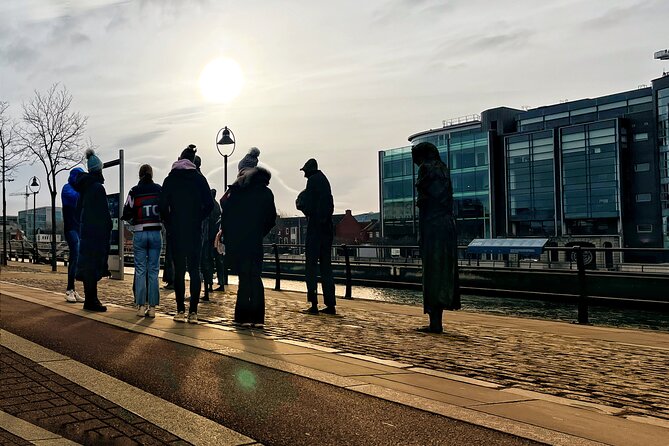
Dublin Castle is the strongest opening point for the Viking and Medieval and Famine routes. You spend about 20 minutes in the grounds, with Barry explaining the site’s history, architecture, and place in Irish public life.
The value here is not simply seeing a famous building. The castle gives you a frame for understanding how Dublin developed as a center of government and power. A guide can connect the stones and courtyards to the wider city, which is useful if you are still getting your bearings.
The stop is also included on two different themed walks, but it serves a different purpose on each. On the medieval route, it helps set up the story of Dublin’s early city and its fortified past. On the Famine route, it provides a starting point for understanding the political decisions and social conditions that shaped later Irish history.
Twenty minutes is enough for an introduction, but not for a full architectural study. If you want to see every room or spend time with individual details, this walk will feel brief. Think of Dublin Castle as a well-chosen lesson stop, not a long indoor visit.
St. Audoen’s Church and the last medieval gateway
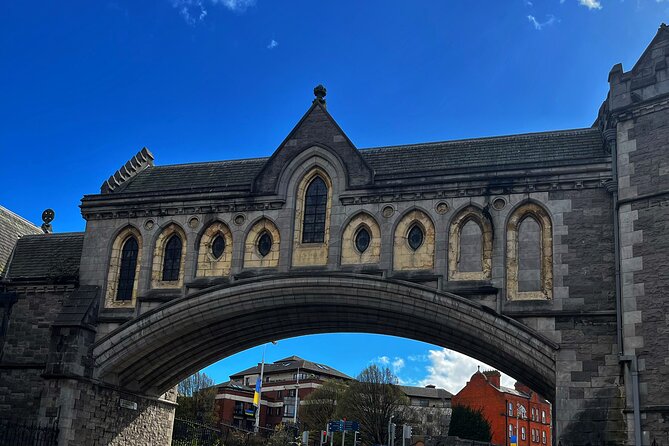
The Viking and Medieval Tour then moves to St. Audoen’s Church, about a 10-minute stop. The church is dedicated to St. Audeon and is described as the only remaining medieval church still operating in Dublin.
That makes it a useful counterpoint to Dublin Castle. The castle represents authority on a large scale, while St. Audoen’s gives you a more direct sense of the old city’s religious and civic life. The stop is short, so Barry’s explanation matters. Without context, an old church can be easy to glance at and forget. With a good story, it becomes part of a larger picture.
After that comes the Old Dublin City Wall. The stop lasts only about five minutes, but the surviving gate is a memorable piece of the walk. It dates from 1240 and leads through a passage into the old medieval city, called the Stairway to Heaven.
I like this part of the route because it asks you to notice what remains rather than only chasing grand monuments. The wall is not a huge attraction with a long visit attached to it. It is a small fragment, and that is precisely why a guide is helpful. Barry can show you how a short passage fits into the city’s former defenses and street plan.
You should wear comfortable shoes. The walk includes several short transitions, and the overall time includes travel between places. The listed 2 hours 40 minutes is not 160 minutes of continuous commentary.
Dame Street and the painful story of the Famine

The Famine Tour takes you along Dame Street to the old Irish Parliament, known locally as Grattan’s Parliament. Built in the early eighteenth century, the building offers a way into Ireland’s political past and the changes that followed its closure at the start of the nineteenth century.
The tour connects that political shift with the severe impact of the Great Famine. This is an important strength of a themed walk. Instead of presenting the Famine as an isolated tragedy, the route places it within the decisions, institutions, and power structures of its time.
The Dame Street stop is listed at about five minutes, so you should expect a focused explanation rather than a long visit inside the building. The subject is serious, and the short format may leave you wanting more. Still, this is the kind of brief city stop that can sharpen your understanding of what you see later in Ireland.
The Famine route also passes the Custom House along the River Liffey. The building is one of Dublin’s finest examples of Georgian architecture and is likely to catch your eye even if architecture is not your main interest. Its position beside the river adds visual variety to a route centered on political and social history.
Something completely different for another day:
- Dublin to Cliffs of Moher, including Wild Atlantic Way and Galway
★ 5.0 · 23,331 reviews - From Dublin: Cliffs of Moher, Burren & Galway City Day Tour
★ 4.8 · 18,888 reviews - Dublin: Guinness Storehouse Entry Ticket
★ 4.6 · 16,863 reviews - Dublin to Cliffs of Moher, Burren, Wild Atlantic Way, Galway Tour
★ 5.0 · 12,924 reviews
Trinity College, Leinster House, and Georgian Dublin
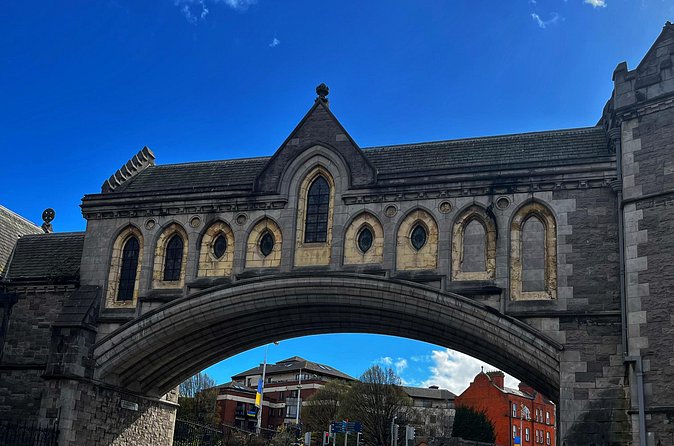
The Georgian Tour moves through Trinity College, Ireland’s oldest university, founded more than 430 years ago. The walk focuses on the institution’s history, so you should see this as a guided look at Trinity’s place in Dublin rather than assume that every campus attraction is included.
The route continues to Leinster House, a building dating from the 1740s and now home to Ireland’s national parliament, the Dáil. Barry explains the building’s architecture and its influence on the growth of Georgian Dublin’s south side.
This is a useful pairing. Trinity College shows the importance of education and national institutions, while Leinster House connects architecture to government. You get a clearer idea of how Dublin’s grand squares and formal streets developed around power, money, and public life.
The Georgian route reaches Merrion Square, described as Dublin’s finest example of a Georgian square. You spend about 20 minutes walking through the square and its classic Jardin Anglaise. The stop also includes the monument to Oscar Wilde, the nineteenth-century novelist and playwright known for his sharp satire.
Merrion Square is likely the most relaxed part of the route. After the heavier political subjects on other walks, the square offers space to look at the buildings, gardens, and street design. Oscar Wilde’s monument adds a literary note without turning the walk into a full literary tour.
If architecture is your main reason for booking, this route may offer the best value. You receive several connected examples rather than a single isolated building. The tradeoff is that the tour may spend less time on medieval Dublin or the 1916 Rising, so choose according to your interests.
O’Connell Street and the Revolutionary Tour

The Revolutionary Tour follows Dublin’s main thoroughfare, O’Connell Street, and includes the General Post Office. The GPO is one of the last major Georgian buildings in Dublin and served as headquarters during the 1916 Rebellion.
This is a strong stop for understanding how an ordinary city street became tied to one of the defining events in modern Irish history. The building is not treated only as an architectural object. Its role in the rebellion gives the surrounding street a political charge.
The tour continues to the Garden of Remembrance. Here, you learn about the Irish Volunteers who were held overnight after surrendering to British forces. The stop lasts about 10 minutes.
The Garden of Remembrance is a quiet place, and the subject calls for a measured explanation. You may find this route more emotionally demanding than the Georgian walk because it deals directly with conflict, surrender, imprisonment, and national memory.
The tour also passes the Hugh Lane Art Gallery on Parnell Square. The gallery houses examples of Impressionist and early twentieth-century art. The route does not list an admission visit, so you should not expect time to explore the collection unless you return separately.
Tenement life and James Joyce’s Dublin

The Revolutionary Tour continues along North Great George’s Street, one of the finest examples of Georgian Dublin. Here the subject shifts from national rebellion to daily life in the city’s tenements during the late nineteenth and early twentieth centuries.
This is one of the more useful parts of the walk because grand Georgian streets can hide difficult living conditions. The architecture may look orderly and impressive, but the story of the people who lived inside those buildings adds needed balance.
The route passes the James Joyce Centre, which celebrates the author and his novel Ulysses. The book describes a single day in Dublin and is often credited with helping create the modern novel.
You do not need to be a Joyce specialist to benefit from this stop. It links literature to place, showing how Dublin’s streets became part of a major work of fiction. If you already know Ulysses, the stop may be especially rewarding. If you do not, it still offers a clear reason to notice the city as a literary setting.
Barry OBrien’s guiding style

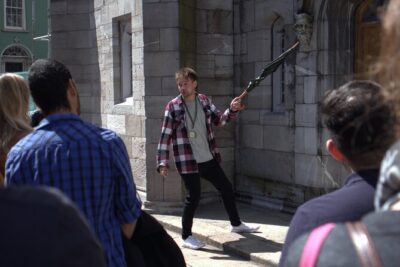
The strongest praise for this experience centers on Barry OBrien, also called Finbarr Barry. The comments describe him as warm, generous with his time, open to questions, and able to explain Irish history through stories rather than dry facts.
One particularly useful detail is his interest in lesser-visited places. That fits the route well. Dublin Castle and Trinity College are familiar names, but the old city-wall gate, St. Audoen’s Church, and the stories behind Georgian streets can easily be missed if you explore without local guidance.
I also like that the format appears suited to conversation. With a maximum of 15 people, you have a better chance of asking about a building, changing the pace of a discussion, or getting clarification on a complicated point. A much larger group can turn a walking tour into a follow-the-umbrella exercise. This one is small enough to feel more personal.
The only caution is that your experience will depend heavily on the guide and the route you select. The praise for Barry is very strong, but the details supplied identify him as the provider rather than promising that every departure has a different guide. If hearing from Barry specifically matters to you, confirm that point when booking.
Is $30.23 a fair price?
At $30.23 per person, the tour is fairly priced for an English-language city walk lasting roughly 2 hours 40 minutes from start to finish. The group limit helps the value, and the route brings together sites that would otherwise require your own research.
The price looks strongest if you want context. You are not paying simply to walk past Dublin Castle or Merrion Square. You are paying for the links between buildings, political events, architecture, literature, and everyday life.
Keep the duration wording in mind. The information states that the guided tour itself lasts about 1 hour 10 minutes, while the remaining time covers travel and walking. That means the price is less attractive if you expect nearly three hours of uninterrupted explanation.
Admission is included where noted, and there is no separate charge for the free-entry stops. Coffee and tea are not included. The tour starts at 10:00 a.m., and the activity ends somewhere different from its starting point, so plan your next appointment with enough time for the final walk.
Who should book this Dublin walk?
I would recommend Hibernoceltic to you if you like history explained through places. It suits first-time Dublin visitors who want a useful city orientation, as well as repeat visitors who have already seen the main sights and want smaller details and local stories.
The Viking and Medieval route is best for you if you want old churches, city walls, gates, and the early shape of Dublin. The Famine Tour suits you if political history and the causes behind Ireland’s nineteenth-century crisis interest you.
Choose the Georgian Tour for architecture, Trinity College, Leinster House, Merrion Square, and Oscar Wilde. Pick the Revolutionary Tour if you want the GPO, the Garden of Remembrance, tenement life, and the literary connection to James Joyce.
I would be less enthusiastic if you want a long museum visit, extensive interior access, or a slow photography walk. Several stops last only five or 10 minutes. This is a moving story walk, not a series of detailed building tours.
The tour is offered in English, uses a mobile ticket, and is near public transportation. Most people can participate, according to the supplied details. Free cancellation is available up to 24 hours before the local start time, but late cancellations and late changes are not accepted. The experience also requires a minimum number of participants, so a cancellation for that reason may lead to another date, another experience, or a full refund.
Final verdict: choose your history, then book
I would book this tour for the guide-led storytelling and the chance to see parts of Dublin that are easy to overlook. Barry OBrien’s warmth, patience, and generosity are the clearest reasons to choose Hibernoceltic, while the small group keeps the experience from feeling anonymous.
The key is to pick the right theme. Do not book expecting one route to cover every stop listed here. Select medieval, Famine, Georgian, or Revolutionary based on the chapter of Dublin you most want to understand.
At $30.23, it is a sensible buy for a compact, English-language introduction to the city. Just allow for walking between stops, expect only about 70 minutes of formal guiding, and leave room in your schedule after the tour because it ends in a different place.
FAQ
Where does the Dublin Hibernoceltic walking tour take place?
The experience takes place in Dublin, Ireland. The exact places depend on the themed route you book, with options covering medieval, Famine, Georgian, and Revolutionary history.
How long does the tour last?
The overall activity is approximately 2 hours 40 minutes. About 1 hour and 10 minutes is guided touring, while the remaining time is used for walking and travel between locations.
What time does the tour start?
The listed start time is 10:00 a.m.
What languages are offered?
The tour is offered in English.
How many people can join the tour?
The group has a maximum of 15 participants.
Is admission included?
Admission is included where specified. Some stops, including St. Audoen’s Church, have free admission. The tour does not include coffee or tea.
Which places are included on the Viking and Medieval Tour?
The Viking and Medieval Tour includes Dublin Castle, St. Audoen’s Church, and the remaining gate of Dublin’s old city wall.
Which themed tours include Dublin Castle?
Dublin Castle is included on both the Viking and Medieval Tour and the Famine Tour.
Can I cancel for a full refund?
Yes. You can cancel at least 24 hours before the local start time for a full refund. Cancellations or changes made less than 24 hours before the start are not accepted for a refund.
Newest in Dublin
- Wicklow Mountains Private Day Tour including Glendalough★ 5.0 · 7 reviews
- Wicklow: Private Day Tour from Dublin★ 5.0 · 5 reviews
- From Dublin: Powerscourt House, Guinness Lake & Glendalough★ 5.0 · 2 reviews
- Ultimate Dublin Food Tour★ 4.5 · 2 reviews
- Women Of Ireland: Trailblazers & Pioneers★ 5.0 · 4 reviews
- Wicklow tour of Glendalough★ 4.5 · 8 reviews
- Wicklow Mountains & Glendalough Luxury Private Day Tour★ 5.0 · 23 reviews
- Whiskey Tasting Tour of Dublin★ 5.0 · 117 reviews
Walking Tours, compared.
Dublin Highlights and Hidden Gems Guided Walking Tour
Read our review →

90 Minute Dublin Walking tour and Sightseeing tips
Read our review →

Historical 2-Hour Guided Walking Tour of Dublin
Read our review →
Dublin Traditional Irish 3 Course Meal Walking Tour with Local
Read our review →
Browse the lists this tour appears in