
Reviewed · WALKING TOURS
Macabre, Ghostly & Bloody Walking Tour
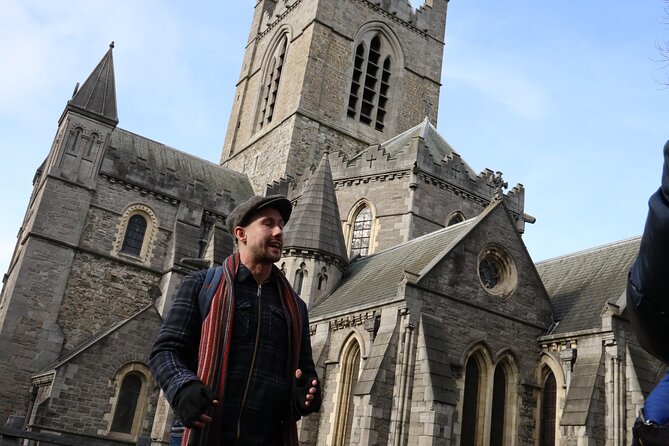
Dublin has a dark side. This two-hour evening walk takes you beyond the usual sights, from Viking rituals and Victorian grave robbers to mummified bodies and a soldier eaten by rats. I like the unusual route and the way it links grim tales to ordinary streets. I also like that guides such as Peter and Rob bring humor and broad Dublin knowledge to the walk. The main consideration is that the subject matter is often graphic, so this is not a gentle ghost story stroll.
The tour costs $20.43 per person, which I consider fair for a small-group walk with a professional guide and eight stops. It is capped at 25 people, though the size of your actual group may vary. You should also remember that this is an outdoor walking tour starting at 6:00 pm, so comfortable shoes and a weather-ready jacket matter.
In This Review
- Six things to know before you go
- Dublin after dark, with the polite version removed
- The Spire and the first turn toward darker Dublin
- Cuchulainn at the General Post Office
- Wolfe Tone Park, grave robbers, and Arthur Guinness
- Oxmantown and the Viking rituals of the old market
- Father Matthew Bridge and the man-eating rats
- St. Audoen’s Church and the Black Death cages
- Fishamble Street and the brothel keeper burned at the stake
- St. Michan’s Church and the mummified corpses
- Is $20.43 a fair price?
- Guides who make the difference
- Who should book this Dublin walk?
- Should you book the Macabre, Ghostly & Bloody Walking Tour?
- FAQ
- How long does the Macabre, Ghostly & Bloody Walking Tour last?
- Where does the tour start?
- What time does the tour begin?
- Where does the tour finish?
- What language is the tour offered in?
- How much does the tour cost?
- How large can the tour group be?
- Can I cancel for a full refund?
Six things to know before you go

- The stories are genuinely macabre: Expect plague, grave robbing, executions, serial murder, corpses, and grisly Viking customs.
- You see a different Dublin: The route runs from the Spire to Fishamble Street, with many tales tied to streets and buildings rather than detached museum displays.
- The General Post Office stop has a legendary twist: You hear the story of Cuchulainn’s death beside a major Dublin landmark.
- St. Michan’s Church is the finale: The walk ends near the church known for its mummified corpses and a tale involving a legless serial killer.
- The guides are a major strength: Peter has been praised for adding general Dublin background and useful local recommendations, while Rob is described as enthusiastic, funny, and captivating.
- The finish is well placed: You end beside Christchurch Cathedral and the Temple Bar District, making it easy to continue your evening.
Dublin after dark, with the polite version removed
Most introductions to Dublin begin with literary heroes, Georgian doors, music, and a pint. This tour takes another road. It asks what happened in the city’s alleys, churchyards, markets, bridges, and old defensive walls when life was far less tidy.
I like that the tour does not depend only on vague ghost stories. Its subject matter reaches into public executions, disease, warfare, religion, crime, and folklore. You get the eerie mood of a nighttime walk, but also enough historical context to understand why these places mattered.
The tour begins at 6:00 pm beside the Spire on O’Connell Street Upper. That is a practical meeting place in central Dublin, and the 120-metre sculpture is hard to miss. The walk then heads south toward the older quarters, finishing on Fishamble Street near Christchurch Cathedral and Temple Bar.
Each stop lasts about 15 minutes. That gives the guide time to tell a proper story without leaving you planted in one place for too long. It also means the two-hour schedule has a steady rhythm, with frequent movement between locations.
More Walking Tours in Dublin
- Dublin Highlights and Hidden Gems Guided Walking Tour
★ 5.0 · 6,020 reviews - Dublin: Highlights and Hidden Gems Walking Tour
★ 4.9 · 2,140 reviews - 1916 Rebellion Walking Tour
★ 5.0 · 1,605 reviews
The Spire and the first turn toward darker Dublin
The Spire is a modern landmark, but it makes a useful starting point because you can find it easily and orient yourself quickly. From here, the tour shifts away from the broad central avenue and into stories connected with Dublin’s older streets.
I would arrive a few minutes early. The meeting point is listed as the Spire on O’Connell Street Upper, and central Dublin can be busy around evening time. Since the tour is in English, you need enough comfort with spoken English to follow fast-moving stories, names, and details.
The first section sets the tone rather than delivering the most gruesome material at once. You are moving through a working city, not entering a staged haunted attraction. That distinction matters. The atmosphere comes from the real setting and the contrast between present-day Dublin and the disturbing events attached to it.
Cuchulainn at the General Post Office
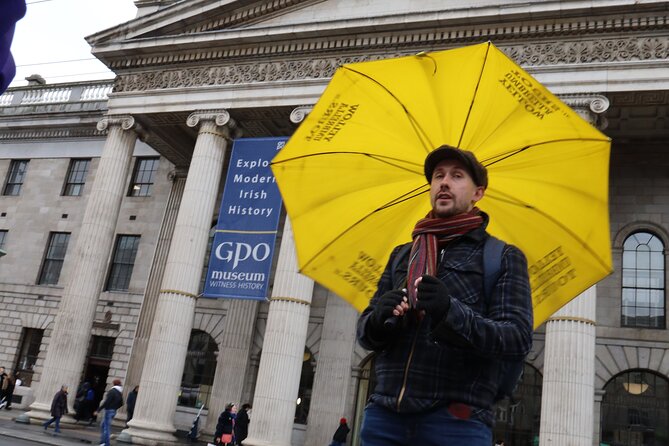
The next stop is An Post’s General Post Office. You view the statue and hear the story of the death of Cuchulainn, one of the great heroic figures of Irish legend.
This stop gives the tour a useful change of scale. The story is not simply about a local criminal or a grisly incident. It reaches into Irish mythology and connects a familiar public building with an older tradition of heroic violence, fate, and death.
The GPO is also one of Dublin’s most recognizable buildings, so the stop helps you see a landmark you may already have passed with fresh eyes. I appreciate that the tour does not reserve the macabre label for murders and corpses. Irish legends can be dark, and this story broadens the walk beyond Victorian crime tales.
The practical drawback is that this is an outdoor storytelling stop. Traffic, pedestrians, and city noise may affect how clearly you hear every word. Staying close to the guide is sensible, especially if the group reaches the full limit of 25 people.
Wolfe Tone Park, grave robbers, and Arthur Guinness
At Wolfe Tone Park, the subject turns to Victorian-era grave robbers. This is one of the strongest examples of how the tour makes its theme relevant to the places around you.
Grave robbing was not just a lurid side note. The practice is tied to the demand for bodies in medical study, which gives the story a grim social context. You are likely to hear about the fear that surrounded burial and the ways criminals profited from death.
The stop also includes the wedding venue of Arthur Guinness. That detail adds an unexpected human contrast. One moment you are hearing about the theft of bodies, and the next you are reminded that the same part of Dublin also hosted an important personal event in the life of the famous brewer.
I like this mixture of the public and private. It keeps the walk from becoming a string of disconnected murders. The guide can show you how one district held celebrations, commerce, faith, and unpleasant business at the same time.
Something completely different for another day:
- Dublin to Cliffs of Moher, including Wild Atlantic Way and Galway
★ 5.0 · 23,331 reviews - From Dublin: Cliffs of Moher, Burren & Galway City Day Tour
★ 4.8 · 18,888 reviews - Dublin: Guinness Storehouse Entry Ticket
★ 4.6 · 16,863 reviews - Dublin to Cliffs of Moher, Burren, Wild Atlantic Way, Galway Tour
★ 5.0 · 12,924 reviews
Oxmantown and the Viking rituals of the old market
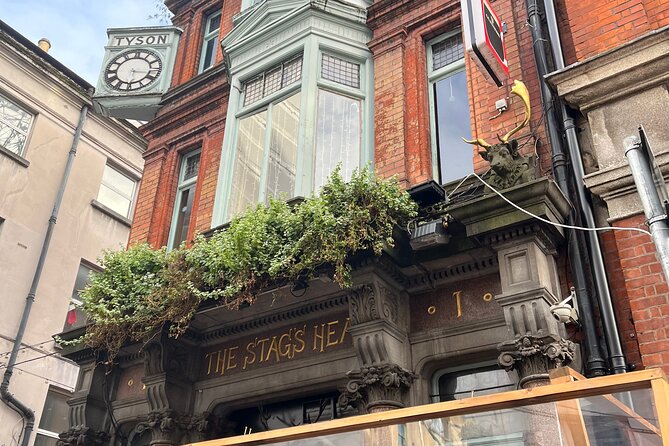
Outside the old fruit and vegetable market in Oxmantown, the tour reaches Dublin’s Viking past. You hear about the area’s connection with the Vikings and some of the more violent aspects of Viking ritual.
This is a good stop for anyone who wants more than modern ghost lore. Dublin’s early story includes settlement, trade, warfare, and ritual, and the tour uses the market area to introduce that older layer of the city.
The phrase macabre can mean different things here. Viking material is not presented simply as a murder mystery. Instead, the focus is on ritual practices and the way death could be treated in a very different society. That makes this part more historical than supernatural.
The old market setting also helps you picture how practical city life once worked. Fruit and vegetables, trade routes, religious customs, and violence all belonged to the same urban world. You do not need to be an expert in Irish or Viking history to follow the story, but the stop rewards curiosity.
Father Matthew Bridge and the man-eating rats
At Father Matthew Bridge, the tour tells the story of a soldier devoured by man-eating rats. It is the kind of tale that sounds almost too horrible to be true, which is exactly why it works well in a macabre walking tour.
The bridge creates a strong setting for the story because you are hearing it beside the water and old city routes rather than in a classroom. I would expect this to be one of the more memorable stops for sheer shock value.
It is also a reminder that older cities had serious problems with sanitation, food storage, overcrowding, and disease. The story is presented as a gruesome episode, but it points toward the harsh conditions that shaped urban life in earlier centuries.
This is one place where personal tolerance matters. If you dislike graphic descriptions of death or animals, you may find the story unpleasant. The tour is designed to tell the darker version of Dublin, and it does not soften every detail.
St. Audoen’s Church and the Black Death cages
At St. Audoen’s Church, you see quarantine cages built into the old city walls, connected with the Black Death. This is one of the most visually distinctive parts of the route because the setting itself helps explain the story.
The cages give you something concrete to examine. Instead of only hearing that disease brought fear and isolation, you see the kind of structure associated with quarantine in the old city. The stop turns a broad subject into a physical detail.
I find this portion especially valuable because it balances the more sensational stories. The Black Death was horrifying, but it was also a public health crisis that changed how communities dealt with illness, movement, and the dead.
St. Audoen’s also helps place you in Dublin’s medieval core. The church and old walls give this section an older feel than the opening stops. If you enjoy architecture and urban history as much as grisly tales, this may be one of the best parts of the walk.
Fishamble Street and the brothel keeper burned at the stake
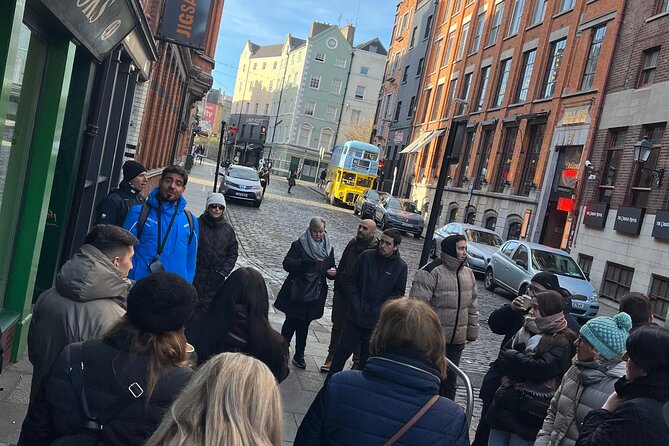
Fishamble Street brings the tour toward its final chapters. Here, the guide tells the story of an infamous brothel keeper and her death by fire at the stake.
The tale shows how crime, sex work, punishment, and public morality intersected in older Dublin. It is not just a story about one notorious person. It also gives you a glimpse of the harsh penalties once used to make examples of people in public.
Fishamble Street is a fitting location because it has an old-city character and sits close to major historic sights. The tour finishes nearby, beside Christchurch Cathedral and the Temple Bar District. That makes this a convenient end point if you want food, music, or another evening activity afterward.
The route does not return you to the Spire. Plan your evening from the southern end of the walk, not the starting point. This is a small detail, but it matters if you have a timed dinner reservation or need to meet someone elsewhere.
St. Michan’s Church and the mummified corpses
The final stop is St. Michan’s Church, where you learn about mummified corpses in the cellar and the story of a legless serial killer. It is a strong ending because the location itself carries an unusual atmosphere.
The mummies provide a physical link to the past, while the serial killer story pushes the tour back toward crime and legend. Together, they give the finale a sharper edge than a simple ghost tale.
I would pay close attention here. Final stops can sometimes feel rushed, but this one contains two of the tour’s most distinctive subjects. The mummified bodies are unusual enough to remain in your memory, and the legless killer story is exactly the sort of strange Dublin detail that most standard sightseeing walks leave out.
The supplied tour information does not state that you enter the church or cellar, so you should not assume an interior visit. The confirmed experience is that you learn about these subjects at St. Michan’s Church.
Is $20.43 a fair price?
At $20.43, I see this as a reasonably priced evening activity, particularly if you enjoy guided storytelling. You are paying for about two hours with a professional guide, not for admission to a collection of attractions.
That distinction is important. The stops are listed as free admission, so the value comes from the route, research, delivery, and interpretation. If you simply walk past these places alone, you will see the buildings but miss the connections between them.
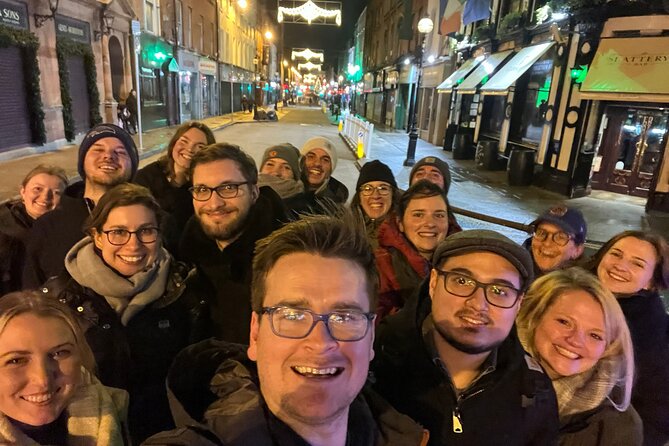
The group limit is 25 people. That is not an intimate private walk, but it is still a manageable size for an outdoor city tour. The smaller the group on your date, the easier it should be to hear the guide and ask questions.
The strongest value comes from the variety. In one short walk, you cover mythology, Vikings, Victorian crime, disease, public punishment, religious sites, and unusual remains. If you want a long museum visit or a formal historical lecture, this is not the right product. If you want stories that make Dublin’s streets more memorable, the price is sensible.
Guides who make the difference
The guide can make or break a storytelling walk. The available feedback is especially strong on this point.
Peter is described as professional and able to discuss both macabre subjects and general Dublin history. He also offered recommendations and small details about the areas along the route. That is useful because you can leave the tour with more than a list of grim stories. You may also gain ideas for the rest of your stay.
Rob is praised for an enthusiastic, funny, and captivating style. The humor matters here. Without some lightness, two hours of plague, executions, corpses, and murder could become heavy going.
One especially interesting detail is that the tour was newly created and, on one occasion, had only one participant. That suggests the experience can sometimes feel more personal than the maximum group size indicates, though you should not book expecting a private tour.
The overall rating is 4.9 from 15 reviews, with 100 percent recommending it. That is a small sample, so I would treat it as encouraging rather than final proof. Still, the praise is consistent: the guides are the main reason the walk works.
Who should book this Dublin walk?
I would recommend it to adults and older teens who enjoy local legends, crime stories, medieval history, and unusual places. It is particularly good for someone who has already seen the standard central sights and wants a different way to understand Dublin.
You should also consider it if you like walking tours with a clear narrative. The route is not a random collection of spooky claims. It moves through several periods and subjects, giving you a broader sense of how the city changed.
I would hesitate if you are sensitive to graphic descriptions of death, disease, execution, or corpses. The title is direct, and the content follows through. This is macabre in a real sense, not just mildly mysterious.
Families need to make their own judgment based on age and comfort. The provided information says most people can participate, but it does not give a specific minimum age or child policy. Service animals are allowed, and the route is near public transportation.
Wear shoes you can walk in for two hours. You start at the Spire and finish near Christchurch Cathedral, so you should also carry a light rain layer for Dublin’s changeable weather. The tour is offered in English only.
Should you book the Macabre, Ghostly & Bloody Walking Tour?
Book it if you want Dublin’s stranger stories, a lively guide, and a central walking route that finishes near Christchurch and Temple Bar. Peter and Rob have set a strong tone in the available feedback, combining humor with useful background rather than simply shouting out ghost stories.
Skip it if you want a calm sightseeing walk, a museum-style presentation, or a tour without graphic material. For the right audience, though, $20.43 buys a memorable evening and a fresh way to see places you might otherwise pass without a second thought.
Free cancellation is available when you cancel at least 24 hours before the 6:00 pm start time. Any cancellation or change made inside that window is not refunded.
FAQ
How long does the Macabre, Ghostly & Bloody Walking Tour last?
The tour lasts approximately two hours, with about 15 minutes scheduled at each of eight stops.
Where does the tour start?
It starts beside the Spire at O’Connell Street Upper, North City, Dublin.
What time does the tour begin?
The start time is 6:00 pm.
Where does the tour finish?
The tour finishes on Fishamble Street, beside Christchurch Cathedral and the Temple Bar District.
What language is the tour offered in?
The tour is offered in English.
How much does the tour cost?
The listed price is $20.43 per person.
How large can the tour group be?
The maximum group size is 25 people.
Can I cancel for a full refund?
Yes. You can cancel at least 24 hours before the experience start time for a full refund. Cancellations or changes made less than 24 hours before the start are not accepted for a refund.
Newest in Dublin
- Wicklow Mountains Private Day Tour including Glendalough★ 5.0 · 7 reviews
- Wicklow: Private Day Tour from Dublin★ 5.0 · 5 reviews
- From Dublin: Powerscourt House, Guinness Lake & Glendalough★ 5.0 · 2 reviews
- Ultimate Dublin Food Tour★ 4.5 · 2 reviews
- Women Of Ireland: Trailblazers & Pioneers★ 5.0 · 4 reviews
- Wicklow tour of Glendalough★ 4.5 · 8 reviews
- Wicklow Mountains & Glendalough Luxury Private Day Tour★ 5.0 · 23 reviews
- Whiskey Tasting Tour of Dublin★ 5.0 · 117 reviews
Walking Tours, compared.
Dublin Highlights and Hidden Gems Guided Walking Tour
Read our review →
90 Minute Dublin Walking tour and Sightseeing tips
Read our review →

Historical 2-Hour Guided Walking Tour of Dublin
Read our review →
Dublin Traditional Irish 3 Course Meal Walking Tour with Local
Read our review →
Browse the lists this tour appears in