
Reviewed · WALKING TOURS
Private Walking Tour in Dublin
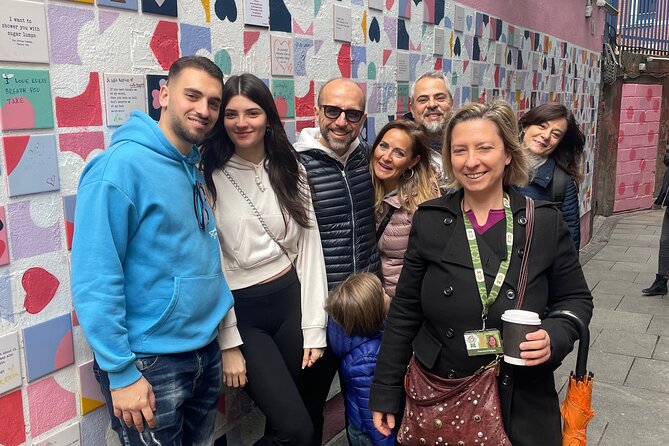
Dublin reveals itself one story at a time. This private walk links Trinity College, the GPO, Temple Bar, the medieval quarter, and Dublin Castle in about two to three hours, giving you a useful first look at the city rather than a single narrow theme. I especially like the private format, since your guide can adjust the pace and answer your questions. I also like the route’s mix of major sights and lesser-known context, from Viking settlement traces at Wood Quay to the political story behind the GPO.
The main drawback is that several important interiors are not included in the $90.11 per-person price, including Trinity College, the GPO Museum, both cathedrals, and Dublin Castle. You will also need decent weather, since the experience can be moved or refunded if poor conditions force cancellation.
In This Review
- Key points to know before booking
- Why this route works as a first look at Dublin
- Trinity College and the literary side of Dublin
- The GPO, the Spire, and Ireland’s fight for independence
- Crossing the Liffey to Ha’penny Bridge and Temple Bar
- Viking Dublin at Wood Quay
- Christ Church and St. Patrick’s: Dublin’s medieval core
- Dublin Castle and the long shadow of British rule
- George’s Street Arcade and Molly Malone
- What the $90.11 price gives you
- Who will enjoy this Dublin walk most
- Practical details that affect your day
- Should you book this private Dublin tour?
- FAQ
- Where does the private walking tour start?
- Where does the tour end?
- How long does the experience last?
- Is the tour private?
- What language is the tour offered in?
- Are admission tickets included?
- Is the tour suitable for children?
- Are service animals allowed?
- What happens if the weather is poor?
- Can I cancel for a full refund?
Key points to know before booking
- A private introduction to Dublin: Only your group takes part, so the walk can respond to your interests and questions.
- A strong first-day route: Eleven stops cover university life, Irish independence, Viking Dublin, medieval churches, Georgian architecture, shopping, and pub culture.
- Several paid sights are viewed from outside: Admission tickets are not included at Trinity College, the GPO Museum, Christ Church Cathedral, St. Patrick’s Cathedral, or Dublin Castle.
- Guides add a personal touch: John, Sinead, Francesca, and Yvonne are named in the feedback, with special praise for their warmth, flexibility, and ability to explain Ireland’s past.
- The walk ends centrally: You finish beside the Molly Malone statue on Suffolk Street, close to many central Dublin sights and streets.
- Good for families and mixed interests: One guide adapted the experience for children aged six and eight, while another shaped the route around the group’s preferences.
Why this route works as a first look at Dublin
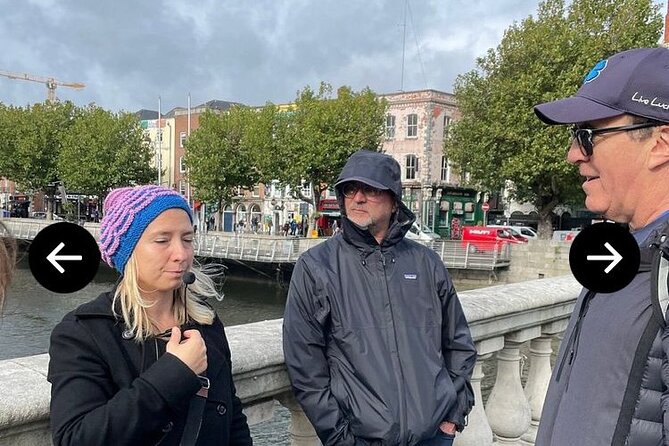
The route begins at Trinity College Dublin and ends at the Molly Malone statue, moving through the city center in a broad arc. That structure matters. You are not spending two hours on one monument or one period of Irish history. Instead, you get a quick introduction to the forces that shaped Dublin: education, British rule, independence, religion, trade, Viking settlement, literature, and popular culture.
I like the way the walk connects famous places with the stories behind them. You see the Spire, Ha’penny Bridge, Temple Bar, and Molly Malone, but you also hear why the GPO matters, where Vikings settled, and how Dublin’s medieval and political centers developed.
The short stop times also tell you what kind of experience this is. Five minutes at the Spire or Molly Malone statue is enough for an explanation and a few photographs, but not a long visit. Fifteen minutes at each cathedral gives you useful context, while the twenty-minute stops at Trinity College and Dublin Castle allow slightly more discussion.
Because the tour is private, you can ask your guide to spend more time on the subjects that catch your attention. The experience is offered in English, and the guides have been praised for answering questions clearly and making the walk comfortable for families.
More Walking Tours in Dublin
- Dublin Highlights and Hidden Gems Guided Walking Tour
★ 5.0 · 6,020 reviews - Dublin: Highlights and Hidden Gems Walking Tour
★ 4.9 · 2,140 reviews - 1916 Rebellion Walking Tour
★ 5.0 · 1,605 reviews
Trinity College and the literary side of Dublin
Trinity College is an excellent starting point. Founded in 1592 by Queen Elizabeth I, it is Ireland’s most prestigious university and feels almost like a small city within Dublin. More than 20,000 people work and study there, so the setting is not simply a museum display. It remains an active part of city life.
The guide can point out the university’s links with famous Irish writers, including Oscar Wilde, Bram Stoker, and Jonathan Swift. That gives you a useful frame for Dublin’s literary reputation, even if you do not enter the historic library or see the Book of Kells during this walk.
Admission is not included, so you should treat this stop as an exterior introduction unless you arrange a separate visit. I see that as a reasonable design choice for a short city orientation. If the Book of Kells is high on your list, plan extra time and a separate ticket rather than expecting this walking tour to cover it.
Starting at Trinity College also puts you in a central, easy-to-reach meeting spot. The tour begins at College Green in Dublin 2, and the private guide meets your group there.
The GPO, the Spire, and Ireland’s fight for independence
The General Post Office gives the route its strongest political chapter. This elegant Georgian building became the headquarters of the 1916 Easter Rising, when members of the Irish Volunteers and the Irish Citizen Army seized it on Easter Monday.
Bullet marks from the fighting can still be seen in the front pillars. That small physical detail makes the event easier to picture than a broad lecture about Irish independence. Your guide can explain why the building became such a powerful symbol of freedom from British rule.
The GPO Museum is not included, so this part of the walk focuses on the building and its place in the story. If you want exhibits and a longer look at the Rising, you would need to pay separately.
Just a short distance away, the Spire provides a sharp change of mood. Officially called the Monument of Light, it rises 120 meters and measures three meters across at its base. It was built to mark the new millennium and is described as the tallest modern art monument in the world.
The five-minute stop is brief, but that is all you need to take in the scale and unusual shape. I would not expect a long art discussion here. The Spire works best as a quick visual landmark between the GPO and the older streets ahead.
Crossing the Liffey to Ha’penny Bridge and Temple Bar
The Ha’penny Bridge is one of Dublin’s most recognizable views. Officially called the Liffey Bridge, it opened in 1816 as Dublin’s first pedestrian bridge. Its famous nickname comes from the half-penny toll once charged to cross it.
The five-minute stop gives you time to hear that story and look along the River Liffey. It also helps you understand Dublin geographically, since the river divides the city center and links several major areas on foot.
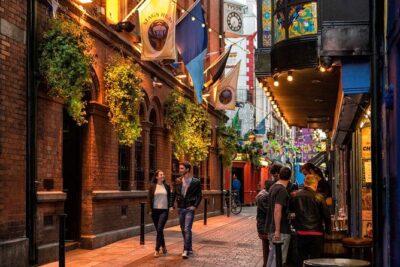
Temple Bar follows, with about fifteen minutes devoted to the old neighborhood. This is Dublin’s best-known cultural and nightlife district, filled with famous pubs, traditional Irish music, restaurants, and narrow streets.
The useful part of seeing Temple Bar with a guide is getting context instead of simply wandering through the busiest pub streets. You can learn about the area’s character and receive suggestions for later food or music stops. One of the most useful comments in the feedback praised a guide’s recommendations for things to do after the tour, which is exactly the sort of help that makes a first-day walk worthwhile.
Still, fifteen minutes is a quick look. You will not sample every restaurant or hear a full music session as part of the tour. Think of Temple Bar as an orientation stop, then return later if you want to eat, listen to music, or explore at a slower pace.
Something completely different for another day:
- Dublin to Cliffs of Moher, including Wild Atlantic Way and Galway
★ 5.0 · 23,331 reviews - From Dublin: Cliffs of Moher, Burren & Galway City Day Tour
★ 4.8 · 18,888 reviews - Dublin: Guinness Storehouse Entry Ticket
★ 4.6 · 16,863 reviews - Dublin to Cliffs of Moher, Burren, Wild Atlantic Way, Galway Tour
★ 5.0 · 12,924 reviews
Viking Dublin at Wood Quay
Wood Quay adds an important layer that many first-time city walks leave out. Archaeologists discovered one of the largest Viking settlements outside Scandinavia in this area while work was being done on the new City Hall.
The Vikings first arrived as raiders and traders, then settled permanently in Dublin in 841 AD. At the Wood Quay Amphitheatre, your guide can connect the modern riverfront with the early settlement that helped shape the city.
This is a particularly good stop for anyone interested in archaeology or the early city. There is no admission fee, and the fifteen-minute visit is long enough for a clear explanation without turning the walk into a specialist lecture.
I also like the change in pace here. After the modern Spire, the political GPO, and the tourist-heavy Temple Bar, Wood Quay reminds you that Dublin’s story began long before the Georgian streets and literary names most people associate with the city.
Christ Church and St. Patrick’s: Dublin’s medieval core
Christ Church Cathedral takes you into Dublin’s medieval district. The church began as a Viking foundation and has welcomed pilgrims and visitors for almost 1,000 years.
Inside are notable features such as Strongbow’s tomb and a copy of the Magna Carta. The cathedral is described as an architectural masterpiece, but you should note that admission is not part of the tour price.
The fifteen-minute stop is best for orientation and a few key stories. If you want time to study the building, its treasures, or its religious significance, plan a separate visit. I would especially consider that option if you enjoy historic churches, since a brief explanation cannot replace time inside.
St. Patrick’s Cathedral is the next major religious stop. The present building was completed between 1225 and 1270 in honor of Ireland’s patron saint. The site is associated with St. Patrick’s baptism of Irish Gaelic people and their conversion to Christianity.
This Gothic church is also linked with Jonathan Swift, whose tomb is inside, along with many other historic objects. Like Christ Church, admission is not included, and the planned stop lasts about fifteen minutes.
Seeing both cathedrals in one route is useful because they show different sides of Dublin’s medieval identity. The tradeoff is simple: you gain comparison and context, but you do not get an extended interior visit at either church.
Dublin Castle and the long shadow of British rule
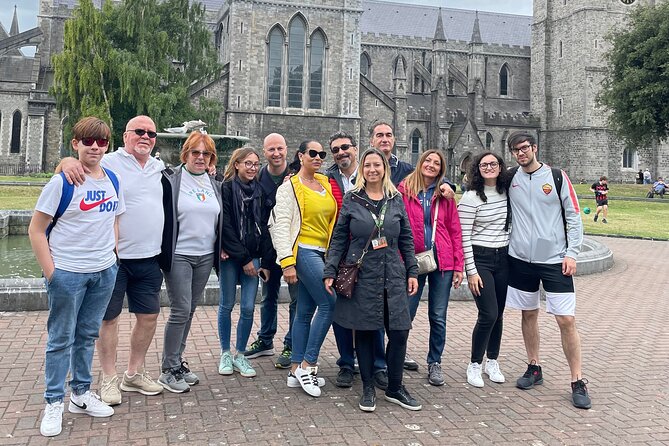
Dublin Castle brings the political story forward. For more than 700 years, it served as the seat of the viceroy, the representative of the English monarch in Ireland.
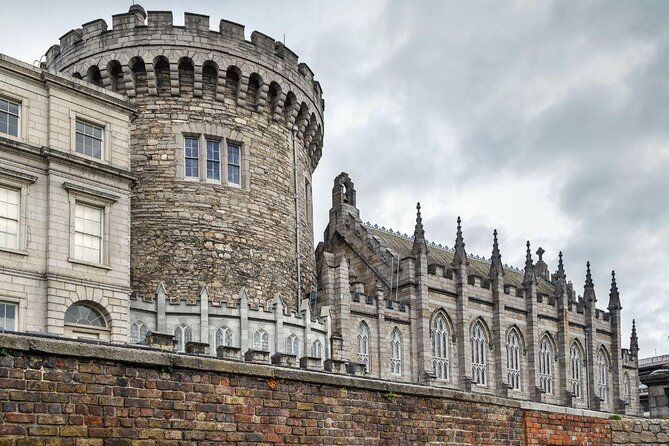
The Record Tower is the only surviving part of the original medieval castle. The rest of the visible complex includes State Apartments built in the eighteenth century. That contrast makes the site especially interesting: what you see is not one untouched medieval fortress, but a place altered by changing rulers and changing needs.
The twenty-minute stop gives your guide room to explain the castle’s role in Irish government. Admission is not included, so the tour provides an outside introduction rather than a full castle visit.
For me, this is one of the most valuable history stops because it helps connect the GPO to a much longer political story. The 1916 Rising did not happen in isolation. Dublin Castle represents the administration that controlled Ireland for centuries, while the GPO represents the push toward independence.
George’s Street Arcade and Molly Malone
George’s Street Arcade offers a lighter, more local-feeling finish. Located in Dublin’s creative quarter, it is the city’s oldest shopping center and one of its clearest examples of Victorian architecture.
The arcade has operated for almost 140 years as part of the South City Market buildings. Its shops and stalls provide a quick look at Dublin’s small-scale retail culture, a useful counterpoint to the larger landmarks earlier in the route.
The five-minute stop is short, but you can return later if a stall catches your eye. Since the tour ends nearby, it is easy to make the arcade part of your own afternoon.
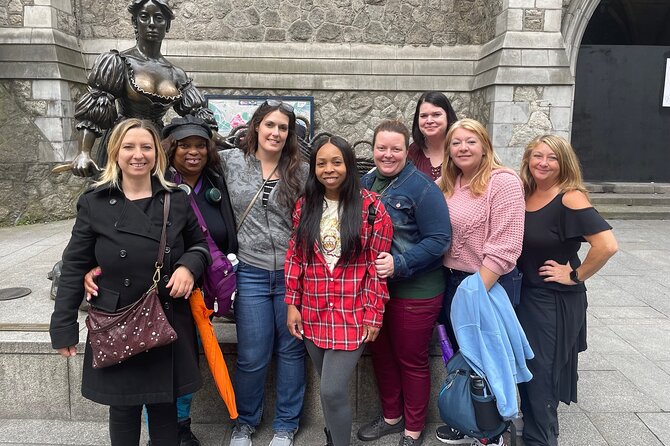
The final stop is the Molly Malone statue on Suffolk Street. Unveiled in 1988 for Dublin’s first millennium, the statue represents the woman from the famous song that has become the city’s unofficial anthem.
Nobody knows for certain if Molly Malone existed. One theory connects her with a real woman who died in Dublin in 1699. The statue is a cheerful final stop, but it also shows how Dublin turns uncertain history into popular civic identity.
You finish directly in front of the statue, in Dublin 2. That gives you a practical chance to continue exploring on your own instead of ending at an out-of-the-way location.
What the $90.11 price gives you
At $90.11 per person, this is not the cheapest way to see Dublin’s exterior landmarks. The value comes from the private guide, the ability to ask questions, and the range of subjects covered in two to three hours.
A private tour can be especially worthwhile if your group has mixed interests. You might care about the Easter Rising, while someone else wants writers, churches, shopping, or food suggestions. The guide can give each person a place in the conversation instead of delivering one fixed speech to a large group.
The price makes less sense if you want long interior visits. Tickets are not included for Trinity College, the GPO Museum, Christ Church Cathedral, St. Patrick’s Cathedral, or Dublin Castle. Add those costs only if you plan to enter them, and allow extra time beyond the walk.
I would see this as a city orientation with expert storytelling, not an all-inclusive sightseeing pass. It can save you from spending your first day guessing which streets and landmarks matter, then leave you with ideas for the rest of your stay.
Who will enjoy this Dublin walk most
I think the tour suits first-time visitors who want a clear introduction before exploring alone. It also fits families well. One guide, John, was specifically praised for accommodating children aged six and eight, which suggests the private format can help keep younger participants involved.
It is also a good choice for couples, friends, and small groups who prefer conversation over a fixed public tour. Sinead was praised for shaping the walk around what the group wanted, while Francesca was described as friendly and helpful with recommendations for later activities.
The tour may be less suitable if you have limited mobility or strongly dislike walking, since the experience is a city walk lasting two to three hours. The available information says most people can participate and that service animals are allowed, but it does not give a precise distance or detailed accessibility plan.
The experience is offered in English. If you need another language, this is not presented as the right choice.
Practical details that affect your day
The walk starts at Trinity College Dublin, College Green, Dublin 2, and ends at the Molly Malone statue on Suffolk Street, Dublin 2, D02 KX03. Both points are in central Dublin and near public transportation.
The expected duration is approximately two to three hours. Since the route includes eleven stops, the pace will be active, with short explanations at some landmarks and longer discussion at Trinity College, the GPO, and Dublin Castle.
The tour is typically reserved about 49 days ahead, so booking early may be sensible if your dates are fixed. Confirmation is normally sent at booking, though reservations made within twelve hours of departure are confirmed as soon as possible, subject to availability.
You can cancel for a full refund up to 24 hours before the start time. Changes or cancellations inside that window are not accepted for a refund. Since good weather is required, a weather cancellation brings the choice of another date or a full refund.
Should you book this private Dublin tour?
Book it if you want a personal, story-led introduction to central Dublin and plan to explore more on your own afterward. The best parts are the range of subjects, the private setting, and the guides’ ability to adapt the experience. The strongest praise goes to Sinead, John, Francesca, and Yvonne for warmth, clear explanations, and thoughtful adjustments to different groups.
Skip it if your priority is spending substantial time inside Trinity College, the GPO Museum, the cathedrals, and Dublin Castle. Those admissions are not included, and the short stops are designed to orient you rather than replace full visits.
For a first morning or afternoon in Dublin, I see real value here. You finish with a better mental map, a stronger sense of how the city developed, and practical ideas for what to do next.
FAQ
Where does the private walking tour start?
It starts at Trinity College Dublin, College Green, Dublin 2, Ireland.
Where does the tour end?
The tour ends in front of the Molly Malone statue on Suffolk Street, Dublin 2, D02 KX03.
How long does the experience last?
The walking tour lasts approximately two to three hours.
Is the tour private?
Yes. Only your group takes part in the activity.
What language is the tour offered in?
The tour is offered in English.
Are admission tickets included?
Admission tickets are not included for Trinity College, the GPO Museum, Christ Church Cathedral, St. Patrick’s Cathedral, or Dublin Castle. The Spire, Ha’penny Bridge, Temple Bar, Wood Quay Amphitheatre, George’s Street Arcade, and Molly Malone statue are listed with free admission.
Is the tour suitable for children?
Most people can participate, and a guide accommodated two children aged six and eight. The experience is private, so your group can discuss pacing and interests with the guide.
Are service animals allowed?
Yes, service animals are allowed.
What happens if the weather is poor?
The experience requires good weather. If it is canceled because of poor conditions, you will be offered a different date or a full refund.
Can I cancel for a full refund?
Yes. You must cancel at least 24 hours before the experience start time for a full refund. Cancellations or changes made less than 24 hours before the start time are not accepted.
Newest in Dublin
- Wicklow Mountains Private Day Tour including Glendalough★ 5.0 · 7 reviews
- Wicklow: Private Day Tour from Dublin★ 5.0 · 5 reviews
- From Dublin: Powerscourt House, Guinness Lake & Glendalough★ 5.0 · 2 reviews
- Ultimate Dublin Food Tour★ 4.5 · 2 reviews
- Women Of Ireland: Trailblazers & Pioneers★ 5.0 · 4 reviews
- Wicklow tour of Glendalough★ 4.5 · 8 reviews
- Wicklow Mountains & Glendalough Luxury Private Day Tour★ 5.0 · 23 reviews
- Whiskey Tasting Tour of Dublin★ 5.0 · 117 reviews
Walking Tours, compared.
Dublin Highlights and Hidden Gems Guided Walking Tour
Read our review →
90 Minute Dublin Walking tour and Sightseeing tips
Read our review →

Historical 2-Hour Guided Walking Tour of Dublin
Read our review →
Dublin Traditional Irish 3 Course Meal Walking Tour with Local
Read our review →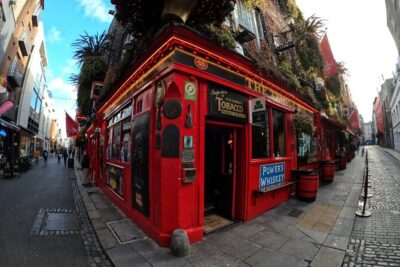
Browse the lists this tour appears in